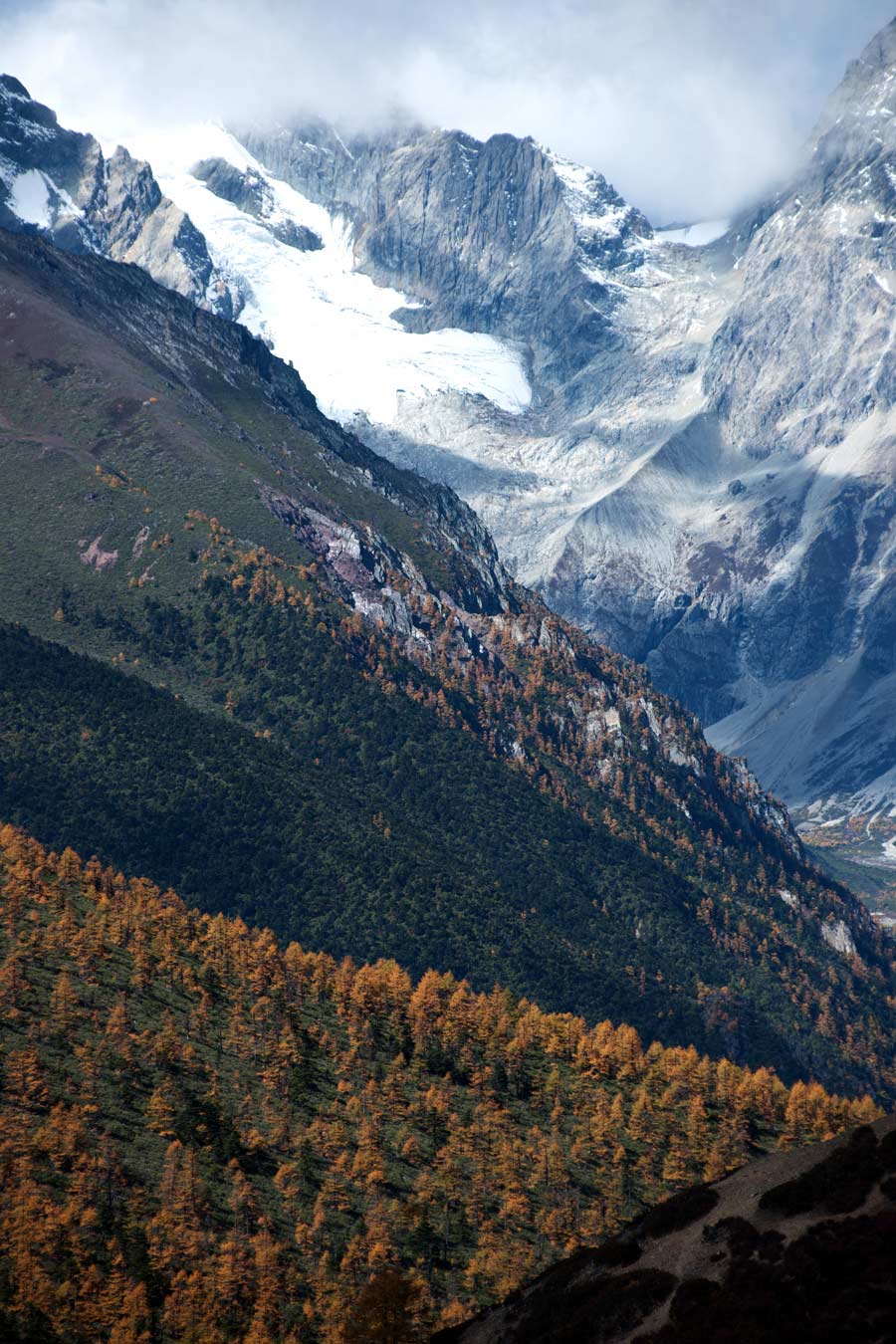
Creating vineyards for high quality wines at high altitude is the challenge taken up by Château Célèbre, Ao Yun, Muxin, Xioa Ling, Shangri-La winery and a few others. Following in the footsteps of the missionary winemakers at the end of the 19th century, the new pioneers have ventured into the Three Rivers region of Yunnan, a system of parallel valleys listed as a UNESCO World Heritage Site. Breathtakingly beautiful, this hard-to-reach region is stirring up passions.
A very Catholic settlement
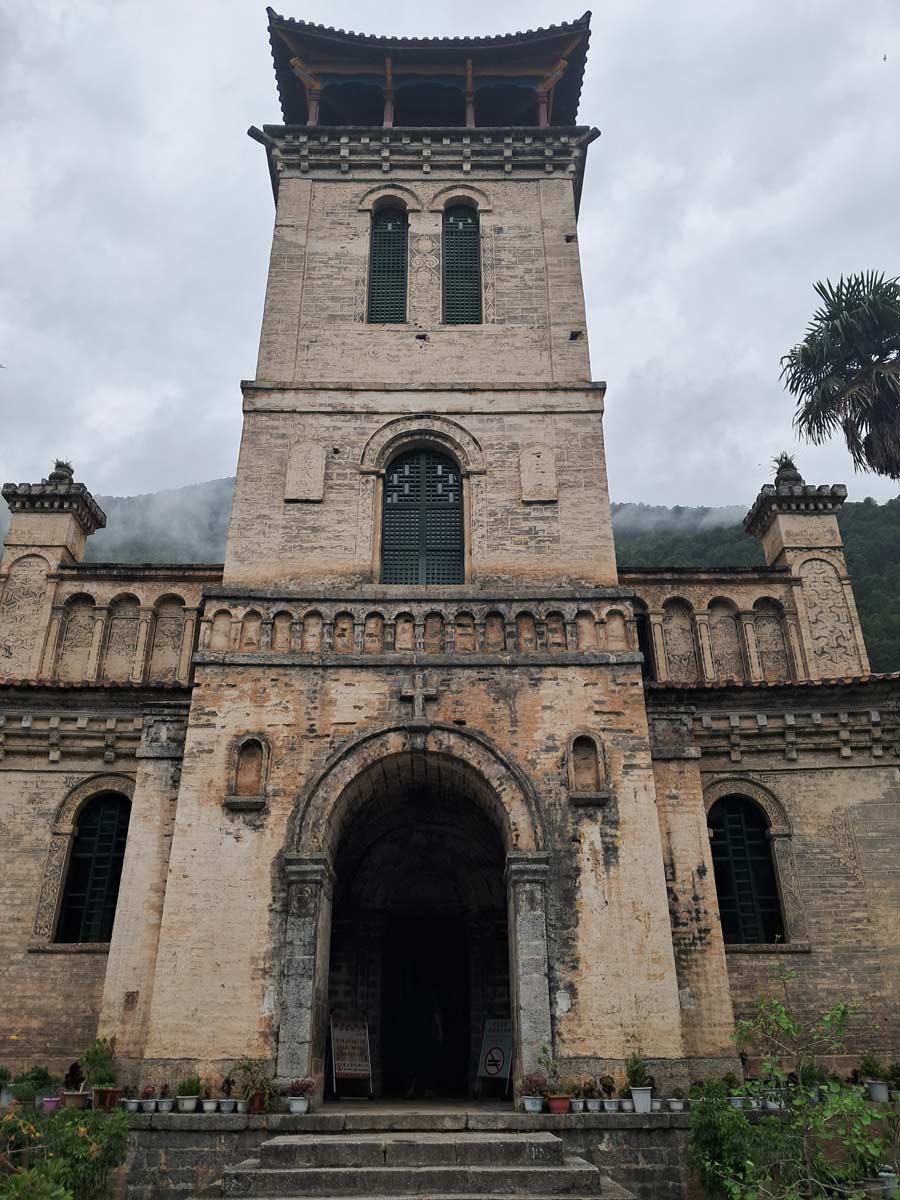
The first missionaries arrived in this valley between Tibet and China in 1865. In 1905, in a climate of high inter-ethnic tensions, the missionaries were slaughtered and their church burnt down. In reparation, the fathers were allowed to build a new church in 1914, surrounded by vineyards. The missionaries were expelled from the country in 1952 and the vineyards left unattended. Only the Bacot Noir survived this fallow period, during which the grapes were eaten. In 1997, a certain Augustin, leader of the Catholic community, relaunched wine production, following government encouragement to develop new products in the region. He enlisted the help of a nun from Yen Ting, who had learnt how to make wine with the missionaries. In just one season, she taught him the basics. Since then, Augustin has encouraged the villagers to follow his example, planting vines and making wine.
In 2002, the government brought in experts, who initially worked with Mei Li Winery. After a few inconclusive years, their competitors at Shangri-La Winery were granted exclusive rights to produce wine in the region. This exclusivity only applies to the creation of new vineyards. Farmers who already own vines are free to sell their production. This allowed new estates to be created, such as Xiao Ling in 2014.
Extreme conditions
This enclave is not so easily tamed, but has attracted the attention of the government, businesses and private individuals alike. The roads linking the main towns in the region have only been paved in recent years. The roads leading from the main arteries up to the villages and vineyards, however, are particularly narrow, skirting vertiginous precipices. And sometimes blocked by landslides, if not by yaks strolling nonchalantly from one side of the road to the other.
In these conditions, it is difficult to transport the technical equipment needed for a winery, however modest it may be. It is also hard to get young, qualified people to work in the vines and vat houses.
Relying on the locals
A mainly Tibetan population inhabits the slopes and plateaux of these valleys. For generations, they have lived there in virtual autarky, practising mixed farming in small hamlets made up of a few families scattered across the mountainsides. The government is trying to bring these families together by creating villages to provide them with education – many of the people in their forties are illiterate – and health services.
The wineries rely on this network of families, both to rent their vineyards and to tend to them. These farmers, who are used to producing as much fruit as possible (for consumption or sale), need to understand the benefits of limiting vine yields to improve fruit quality — a subtle balance that estates and owners must navigate together.
To achieve this, the estates rely on local organisation: a few families, grouped together under the authority of a village chief. This person coordinates the day-to-day work in the vineyards with the estate. Technology is used for efficiency. Workers photograph even the smallest stain on a leaf and share it via WeChat groups (the Chinese equivalent of WhatsApp) with the estate’s viticulture manager, who then recommends the appropriate care or visits the site personally.
Like Ao Yun, some estates bring in winemakers from France and viticulturalists from Chinese universities across various regions. Others, like Xiao Ling, rely on local youth to manage vineyards and learn from expert advisers and community knowledge. This blend of global expertise and local tradition shapes a unique approach to winemaking in the region.
A perched nature
Importing plant material is forbidden. Growers purchase some vine stocks from Chinese nurseries, while they inherit a large part from past generations, with the origin often unknown. The vineyards, like the hamlets, spread all along the valleys, clinging to the mountainsides or terraces at altitudes between 1,800 and 2,800 metres.
The air here is more subtle than elsewhere. The sun, while not appearing until relatively late in the morning, shines more brightly than at lower altitudes. The fresh water flowing down from the mountain tops is diverted through cleverly designed pipes to enable irrigation to be adapted to needs – drip-fed or with all valves open. Despite the altitude, temperatures do not generally fall below -2°C in winter. The vines do not need to be buried, as is the case in many other Chinese wine-growing regions. Instead of taking between 100 and 120 days, as in Europe, the grapes take between 150 and 160 days to ripen.
Viticulturists and winemakers are learning to tame these differences in order to make the best wine in the world from high quality grapes.
Big and small
In every other way, they are different. Shangri-La winery was commissioned by the government at the beginning of this century to develop the region’s wine industry. With access to a huge area of vines, it led the way in testing different grape varieties and blends for the region.
Two brothers originally from the tea trade created Célébre. After a foray into the world of wine and several visits to Bordeaux to learn about viticulture, they created Célèbre. A Bordeaux blend, Dan Shen Di, their range of generous plot wines and Allofme, their range of pleasure wines. Advised by consultant Patrick Valette, his son-in-law Vianney Jacqmin is now in charge of the vines and winery.
Nothing brings them together: nationalities, ideas, means or know-how.
Ao Yun, LVMH’s Chinese estate, whose red Ao Yun grand vin is marketed by La Place de Bordeaux. Alongside it, Ao Yun white and three plot-based cuvées. A white wine, from the COVID 2020 vintage, which won the admiration of the team for its great finesse.
Mu Chao, a young Chinese from Tsing Tao who worked with some of the greatest French and American winemakers, has recently created his own domaine MuXin. The range is limited to a Chardonnay of incomparable finesse and a blended red. These wines are driven by the young man’s quest for perfection.
Xiao Ling is following in the footsteps of the missionaries. Initially accompanied by Yves Roduit, who came from Switzerland to spend 2 years. Followed byMu Chao, who stayed for three harvests. More recently, in line with their desire to support the development of local skills, the duo: Fung Tien and Li Da. Sylvain Pitiot, a partner in the adventure, supervises the advancement.
Apart from their choice to bring a touch of civilisation to an extra-ordinary, nothing brings them together: neither their nationalities, ideas, means or know-how.
They are paving the way and creating envy among the major international players, such as Penfolds, or local players such as Xige, the young Chinese duo, Petit Mont. Others do not feel ready to show us the results of their first harvest. A good reason to return in a few years’ time.
A touch of humanitarianism
Célèbre and Xiao Ling estates have both decided to support the local populations on whom they rely for their estates.
Xiaoling supports the populations of the Catholic villages of Upper Mekong with the Sentiers du ciel association. They favour the use of local labour rather than automation, and give priority to local purchases wherever possible. During the harvest, whole villages work on sorting the grapes and in the cellar. They employ the elderly and those who speak poor Chinese who cannot work elsewhere.
Célèbre, meanwhile, have created their third range of wines, Allofme, with affordable styles and prices. Part of the proceeds go towards supporting Tibetan women, foundation of the villages, looking after both children and land.