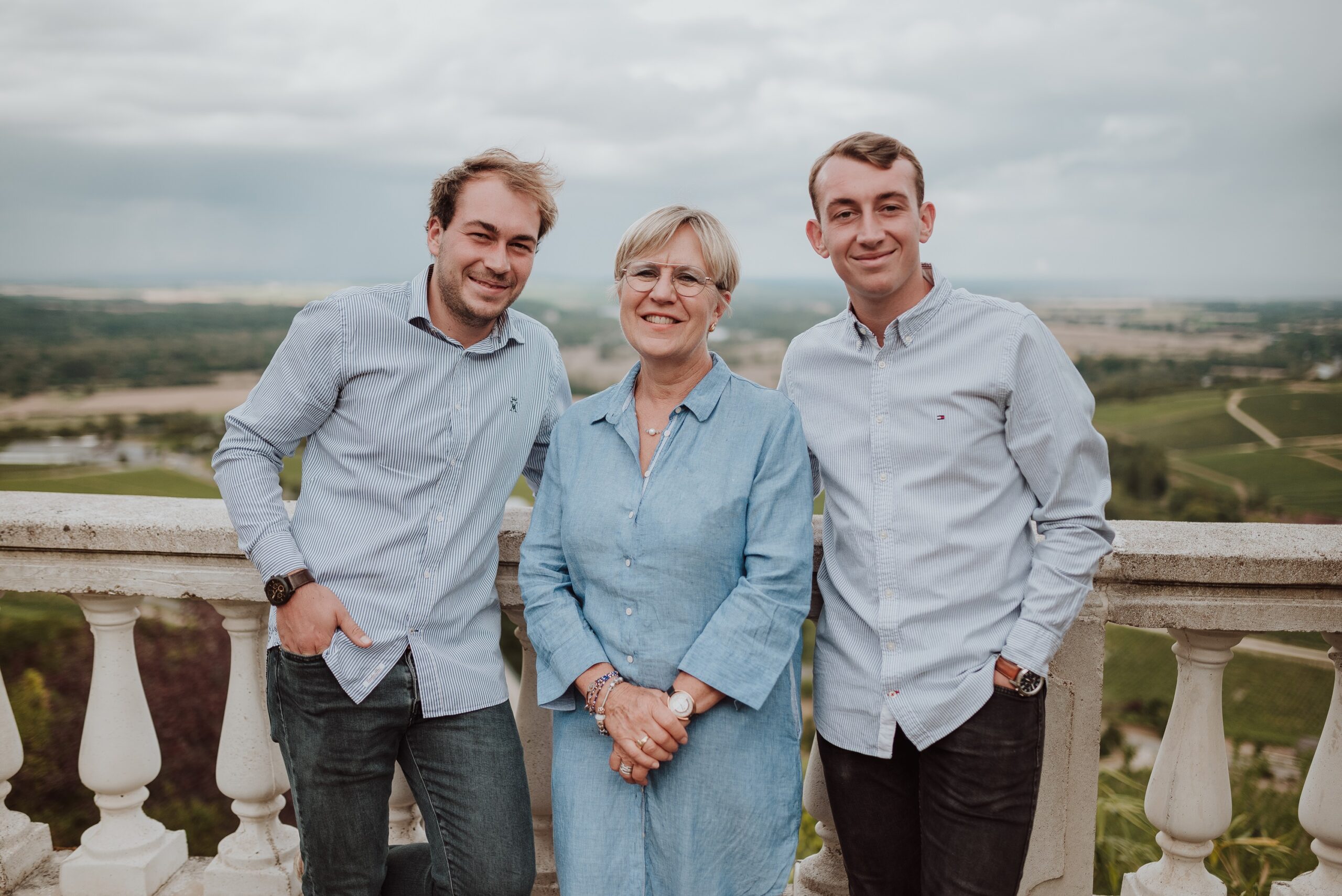
.Joseph Mellot, Loire in their veins. Five hundred years of history have enabled the Joseph Mellot estate to establish itself as one of the leading wine-producing institutions in the Loire Valley. While this success is the work of a family, it also owes much to the courage and determination of one woman, Catherine Corbeau-Mellot, who prepared her children to show the same passion.
In a nod to history, Catherine Corbeau-Mellot introduces us to the terroirs of the Joseph Mellot estate, starting with those of the Pouilly-Fumé appellation. It is as if to remind us that this Loire institution, whose winemaking history dates back to 1513, is looking to the future. At the wheel of her car, driving slowly along the muddy tracks that mark the boundaries of the plots where a few downy buds are just beginning to appear, she seems to be looking at the work that remains to be done rather than what has already been accomplished.
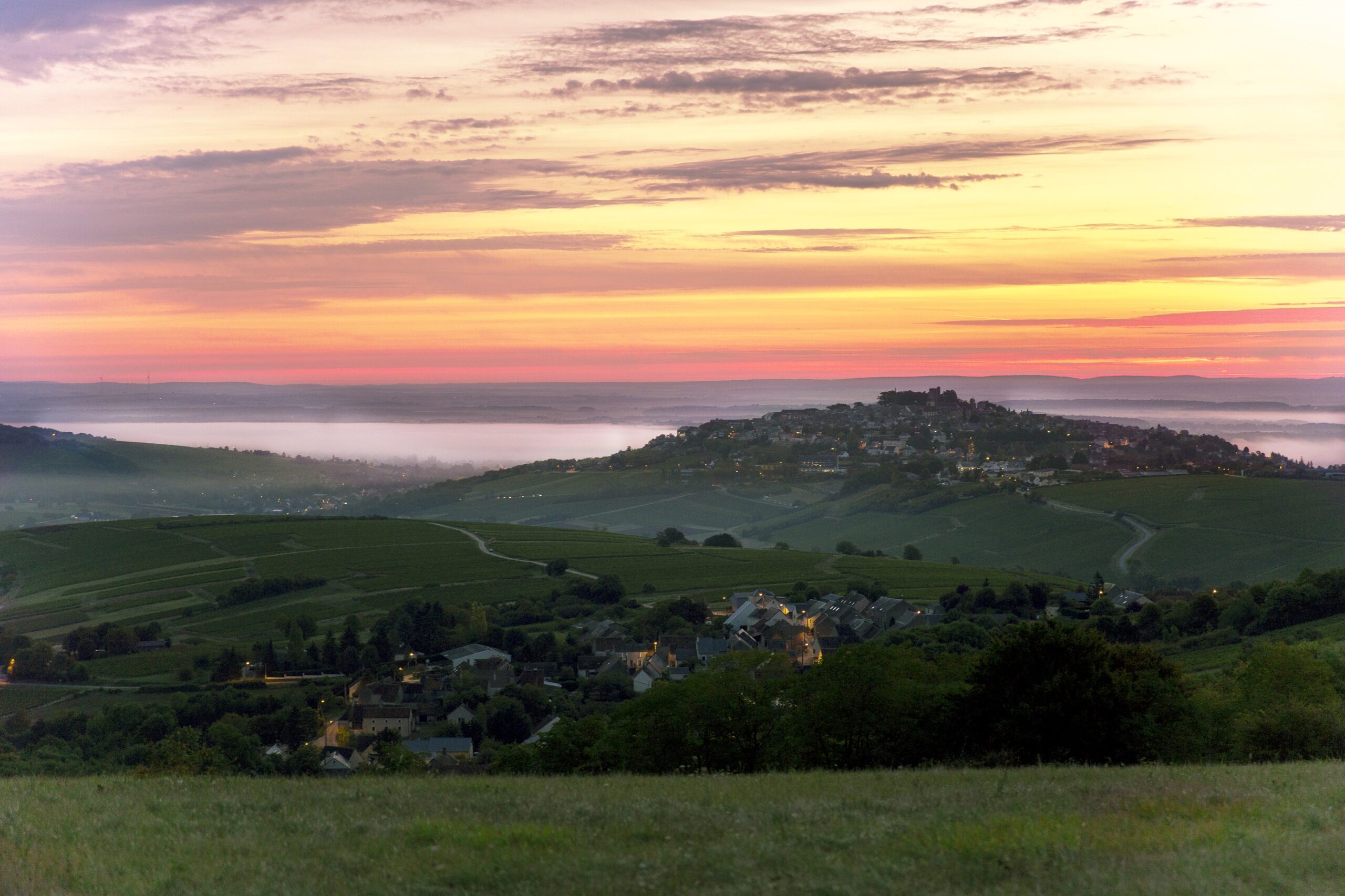
Closely linked to the history of the Sancerre region, the Mellot family (Joseph branch) has been present for over forty years in Pouilly-Fumé, the neighbouring village. In 1981, it acquired the Troncsec vineyard, named after the locality located to the north of the appellation. In less than fifty years, these ten hectares have become a laboratory for the estate, which is conducting trials in sustainable viticulture, implementing respectful cultivation practices (integrated pest management, yield control, plot monitoring, biodiversity protection, etc.). Planted on Kimmeridgian marl soil, Sauvignon Blanc finds its true expression at Troncsec.
“It’s a cool area, facing north-east. The plot we cultivate is located at the very top of this hill,” explains Catherine Corbeau-Mellot. Her teams confirm this during our visit. The area is prone to frost and bad weather, particularly hail, but also to stagnant humidity emanating from the woods below. The teams working for Adrien Mellot, Catherine’s son, who joined her to take care of the vineyard, do not practise organic viticulture here, as they do on the 14 hectares of the Domaine des Mariniers, the family’s other property in Pouilly-Fumé.
“Troncsec is in a different situation. And it’s an important wine from a commercial point of view. It’s hard to imagine losing an entire harvest to mildew,” says Catherine Corbeau-Mellot. So, no organic farming, but demanding practices, such as the introduction five years ago of cover crops, with vegetable plants such as field beans sown in the autumn between the rows of the plot. “This allows us to limit the use of fertilisers, and sometimes even do without them altogether,” explains Adrien Mellot, who notes that the Sauvignon vines planted at Troncsec are still well suited to current climatic conditions: “Aromatic and technological ripeness are still simultaneous and water stress, except in hot years, is not a problem. But to be on the safe side, we are now replanting several types of Sauvignon clones.”
500 years of history
Although the Troncsec island produces only one wine, the Mariniers’ Pouilly-Fumé is a blend of plots located in several renowned areas of the appellation, such as Les Berthiers, Boisgibault and around Saint-Andelain. “Our Pouilly-Fumé vineyard has been built up over time and as opportunities arose,” says Catherine Corbeau-Mellot. She admits, without surprise, that the rivalry between the winegrowers of Sancerre and Pouilly-Fumé has sometimes been a burden for her generation, even though the family has always contributed to the reputation of both appellations.
“Today, I am delighted to hear Pouilly-Fumé winegrowers congratulate me on the work of Adrien and his teams,” says , who embodies the face of a family that has been present in the Sancerre region for over five hundred years. The Mellots established themselves as winegrowers in 1513, under the leadership of Pierre Etienne Mellot, the founder of an estate that has become the most emblematic of the appellation over time, even though it has since been divided.
While the name of the patriarch is one to remember, other great men in the family have contributed to the development of Sancerre wines in France and around the world. In addition to César Mellot, who helped King Louis XIV choose wines for his court, we must also mention Alphonse Mellot, the first Sancerre winemaker to exhibit his wines at the Paris Fair in the early 20th century. He was instrumental in accelerating the marketing of Sancerre wines in Paris by structuring distribution in the capital with the opening of a warehouse in the Bercy wine market, which no longer exists today.
His two sons, Joseph and Edmond, succeeded him in 1946. The siblings worked to grow the Mellot brand and boost sales in Europe, particularly in the United Kingdom. Under the impetus of Josette Mellot, Joseph’s wife, the estate was also the first to open a shop in the village where its cellars are located. The shop, called “La Vigne et le Vin” (The Vine and Wine), which still exists today, became another important location for the Mellots on their land, alongside the Auberge Joseph Mellot, the oldest restaurant in Sancerre, founded by the family in 1882.
The Mellot vineyard was divided in 1969, when the two brothers separated to create two branches of the family and two estates. Alexandre, Joseph Mellot’s son, succeeded him in 1984 at the head of a company that was about to enter a new phase in its development. Expanding the vineyard into other appellations, modernising production facilities and conquering new markets marked the beginning of a new adventure for this branch of the family. It was also the beginning of a love story.
Catherine Corbeau-Mellot joined her husband Alexandre in 1987 to take charge of communications and sales management. Together, they had two children, Adrien and Armand, and established the Joseph Mellot brand as one of the leading names in the Centre-Loire region.
The courage of a woman
Originally from Sologne, Catherine Corbeau-Mellot has a flair for business. She is not from the industry, but she loves wine. Encouraged by her husband, she decided to study at the University of Wine in Suze-la-Rousse “to learn the basics and acquire a general knowledge of the subject,” she recalls. “For the rest, I knew I would learn on the job by using common sense and observation.” Which is what she did, with a desire to improve her skills. She took part in her first Vinexpo. “I love business, so I was immediately enthusiastic about this world. ”
She read specialist magazines and compiled press cuttings to help her talk about wine, even though she remained convinced that “those who make it are always the ones who talk about it best”. For the duo, only teamwork counts. “That’s how we are, humble and never self-centred,” she recalls. Alexandre Mellot fell ill and died suddenly in 2005, at the age of 44. He left behind two boys aged seven and six, as well as a business that needed to be taken over. “We had structured things well. My husband’s strength was in sharing. So when he fell ill, the teams knew what they had to do. Everyone took charge. I always knew that I had three children: Adrien, Armand and the estate. I had to raise all three at the same time. ”
In the village, some people thought she wouldn’t succeed. But rather than collapsing in a world that was falling apart, Catherine Corbeau-Mellot found the courage to continue doing what she knows how to do. “I am lucky to have had a strong team around me, with whom I was able to share. To ensure the company’s long-term future, we understood that its operation should not rely solely on us. I have always been able to delegate and entrust responsibilities to people I trust.” She adds, with the clarity of experience: “Most winegrowers are alone. They are their estate. If they are no longer there, everything can come to a halt.”
With her strength of character and courage , which command respect, Catherine Corbeau-Mellot has succeeded in continuing to write the long history of this estate, developing it, but also cultivating a keen sense of transmission. “Many people appreciated Alexandre’s work. So they believed in me, even though I was a woman and, what’s more, not from the area,” she says with a smile. She quickly became involved in the region’s economic and associative fabric. She is president of the exporters’ club at the chamber of commerce. She campaigned against the reduction of tax credits for home help, on the pretext that they were benefits, explaining that “this enables many women to work”.
In 2009, she took part in the Aïcha des Gazelles rally, an exclusively female car rally, to prove that she was “capable of surpassing herself as a woman “. In 2015, she founded the association Les Dames de Cœur de Loire, a regional branch of the national collective Femmes du Vin. She also became co-chair of the Centre-Loire Interprofessional Wine Office (BIVC) before feeling the need to refocus on the estate’s activities. This was in order to respond to the current challenges facing the wine world and to support her sons Adrien and Armand, who had decided to join her. “The family has always been forward-thinking. And I’ve never wanted to miss the boat. I don’t want to pass on something to my sons that is behind the times.”
Times of challenge
It is now up to Adrien and Armand to manage the large vineyards of this centuries-old estate. There is a little pressure, of course, but the two young men seem ready. Each in his own style carries on their parents’ vision, combining humility as winegrowers with business acumen and open-mindedness. Above all, the two brothers are passionate about the terroirs of the Centre-Loire region and their specific characteristics. They will have to face the challenges of a wine world in crisis.
Starting with the daunting task of recruiting qualified staff. Their mother sums up the situation well: “There are too many prejudices surrounding our professions, perpetuated by people who don’t know them well. The challenge is to introduce them to these professions and make them appealing. These are wonderful professions that are constantly being denigrated. We welcome schoolchildren from the region to introduce them to the vineyard and wine professions and show them how diverse they are. There’s work to be done and no one’s talking about it.”
This is a major challenge for a company that employs sixty people, from the vineyard to marketing, and is a member of an employer group for integration and qualification (GEIQ). The estate also has questions about consumer trends. “What can we do to communicate with the younger generations? Break down barriers? Avoid being elitist?” asks Catherine Corbeau-Mellot, for whom this distance seems to be growing. The younger Mellot generation has a plan. It is focusing on quality.
Increasingly precise viticulture, the use of technology with the purchase of a Viti bot work robot, optimised winemaking processes with a project to redesign the cellar created in 1990 to install new presses, smaller vats and more respectful grape conveyors, etc. The focus is on the terroirs.
Another challenge is to develop sales in France in the context of a shrinking international market. True to its history, Joseph Mellot has plans for its village. Completely renovated, its historic cellar now houses the barrels and casks in which certain wines are aged. “We were among the first to build a cellar outside the village in 1990. It was a technically avant-garde building. Investing in this historic cellar is a way of reconnecting with our roots.” What could be more normal, after all, for a family that has contributed like no other to writing the legend of Sancerre and Centre Loire wines? This should continue.
The wines
Joseph Mellot, Domaine Jean-Michel Sorbe, Clos de la Victoire 2023, Quincy
A single vineyard cuvée that showcases old Sauvignon vines (45 years old on average) planted on sandy and gravelly soils. Intense nose with aromas of candied lemon and herbaceous notes. The palate is structured and fleshy. It will evolve towards even greater finesse. 92/100
Joseph Mellot, Domaine des Mariniers 2023, Pouilly-Fumé
An organic Sauvignon made from a blend of several parcels (14 hectares in total) spread across the Pouilly-Fumé appellation, including some renowned areas. Classically crafted, it offers an aromatic palette ranging from citrus notes to characteristic smoky touches. Long, salty finish. 92/100
Joseph Mellot, Le Troncsec 2023, Pouilly-Fumé
The Troncsec plot, a historic acquisition by the family in the Pouilly-Fumé appellation, offers an authentic interpretation of this area of Kimmeridgian limestone marl. Dominated by citrus notes and fresh white fruit, slender and straightforward on the palate, this is an intense wine that will benefit from a few years’ ageing. 94/100
Joseph Mellot, La Châtellenie 2023, Sancerre
A blend of several parcels (18 hectares in total) of Sauvignon on flinty clay soils, the main terroir of the Joseph Mellot estate. Still closed today, as is often the case with wines from this terroir in their youth, but there is power here. A salty, mouth-watering finish. 93/100
Joseph Mellot, Domaine des Émois 2023, Sancerre
Made from organically grown Sauvignon grapes. Almost four hectares in a single block on clay-limestone soils (caillottes) located in the hamlet of Amigny. Expressive nose with notes of citrus and white fruit, straightforward and slender on the palate. We love this white wine’s elegance and lively finish. 92/100
Joseph Mellot, La Grande Châtelaine 2022, Sancerre
From an unclaimed lieu-dit (2.4 hectares in total) and old vines planted on caillottes soils. This is one of the estate’s whites aged in fine-grained oak barrels. Notes of candied citrus, a hint of smoke, full-bodied on the palate, with the typical characteristics of this terroir evident in the full, long and persistent finish. 93/100
Joseph Mellot, La Gravelière 2023, Sancerre
A blend of several parcels (six hectares in total) divided between caillottes and white soils. An intense and structured Sauvignon, pleasantly fruity and rather mineral in character. A perfect classic for introducing oneself to the estate’s unpretentious style. 90/100
Joseph Mellot, Cuvée Pierre-Étienne 2020, Sancerre
This white wine, which pays tribute to the founder of the estate, comes from a plot of Sauvignon on flint (0.8 hectares). It is aged in barrels, which helps to tame its structured texture with a noticeable minerality, ripe yellow fruit notes (mirabelle plum, apricot) and a few spicy touches make this an energetic and nuanced wine. 94/100
Joseph Mellot, Les Vignes du Rocher 2023, Sancerre
Produced from a 1.3-hectare plot located on the Piton de Sancerre, an extremely steep flint hillside that produces a sunny and powerful wine. A precise and chiselled mineral expression of Sancerre Sauvignon, with ripe fruit flavours balanced by a lovely freshness in this vintage. Lots of personality. 95/100