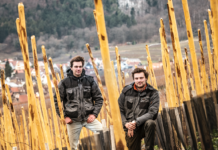
Californian David Pearson has had an unusual career path, taking him from Languedoc to the finest wines of Napa Valley: world winemaker. With uncommon conviction and an intact humanistic freshness, he draws lessons from a life spent among great wines and is enthusiastic about his new project at the helm of a Napa legend, Joseph Phelps Vineyards.
“Before I reached adulthood, I had no contact with or experience of wine. It’s funny, because I was planning to enrol at the University of California, Davis, without knowing that it had a wine school.” Forty-five years later, David Pearson has one of the most prestigious CVs in global viticulture. A winemaker in California, then the driving force behind Robert Mondavi’s aborted projects in Languedoc, he went on to run the legendary Californian estate Opus One for some fifteen years before turning his attention to Joseph Phelps Vineyards, another Napa Valley icon, which he took over at the request of its new shareholder LVMH in 2023.
David Pearson spent his childhood and teenage years in San José, southern California, in an environment far removed from the wine culture he would soon become part of. “In the summer of 1980, my older brother and I travelled to Europe for the first time. We spent two months there, with only our backpacks, travelling by train. My brother had planned the entire itinerary and I followed him without question. It turned out that our maternal uncle was a wine distributor in Tennessee. Thanks to this, we met Armand Cottin, the owner of Labouré-Roi (a Burgundy winery that no longer exists, ed.). He was a warm, smiling and enthusiastic man, a kind of Willy Wonka of wine. He took us on a tour of the great vineyards of Burgundy. I was still tired from jet lag, so I dozed off a bit. However, this experience had a profound effect on me. After returning to California, I started my studies at university. It was almost by chance that I discovered oenology. The course lasted four years, with the first two years devoted to basic sciences such as physics, chemistry and biology, before really diving into the world of wine in the third year. I took it lightly, telling myself that the first two years would be fun and that the serious stuff would start in the third year.”
Thanks to the Cottin family, who have properties in both Burgundy and the Médoc, David Pearson truly discovered French wine in 1984. A year of work in Bordeaux was punctuated by the discovery of an unknown world. “At the weekend, I had a 2CV which allowed me to visit the Médoc. I would turn up without an appointment. I spoke better French at the time and introduced myself as a young Californian oenologist who wanted to talk about wine. Three out of four winegrowers refused to see me. I asked Philippe Cottin why, and he explained that in the time, châteaux only called on oenologists when they encountered problems. So if a neighbouring château saw an oenologist arrive, it meant they had problems. That’s why I was rarely welcomed, except discreetly, away from prying eyes. This came as a shock to me because I had studied biochemistry, biology and winemaking techniques, but nothing about the feel of wine, about the art of it. I wondered how malolactic fermentation could be controlled and measured. As I asked this question, I began to realise that there were two completely different worlds.”
ADVENTURE IN LANGUEDOC
After completing his studies, Pearson became a true Californian winemaker, but his insatiable curiosity soon prompted him to take another step in a new direction. “I decided to join a research centre in Connecticut to devote myself to sensory analysis. After six years of working there, I came to the conclusion that our brains anticipate the taste of what we are about to taste even before we have tasted it. For example, when I tasted Mouton Rothschild, all the knowledge I had already accumulated about this wine resurfaced unconsciously, influencing my perception of its taste. This is why a blind tasting is different from a tasting where you already know the wine. Taste and sensations are not absolutes, but variables. This observation, suggesting that it is our imagination that determines our appreciation of a wine rather than a hierarchy dictated by the pedigree of the terroir, may shock purists, but it opens up new perspectives for contemporary vineyards.”
With an MBA in international business under his belt, he was ready to embark on a career in winery management, which he began with a now famous project: Robert Mondavi’s aborted venture in Aniane, in the heart of the Languedoc region. “Michael Mondavi (one of Robert’s two sons, ed.) asked me if I could move to Montpellier to supervise a vineyard creation project. After careful consideration, at the age of 34, with my wife and three children, we accepted, telling ourselves that we were going to have a unique experience. It was a dream project, because it involved building something from scratch. The idea was to establish a base with a small company and identify vineyards to produce exceptional wine. That was Mondavi’s model at the time, as he wanted to create great terroir wines in France. He gave me no guidelines and left me to manage everything. I had the freedom to choose any location in France, which was extraordinary. Our goal was to create an authentic, credible, high-quality wine, not just to buy a vineyard. People were surprised; they weren’t expecting it. For a year and a half, it was like walking on a red carpet for me, except for the owners who were afraid we would buy their vineyards. The best and most dynamic ones didn’t want to sell, which is understandable. During this period, I recruited Thomas Duroux (now director of Château Palmer,ed.) and we began an in-depth study to analyse
THE MAN BEHIND OPUS ONE
The misadventures in Languedoc of the Mondavi fa
mily, David Pearson (who nevertheless spent three years there with his wife and children) and Thomas Duroux would be worthy of an entire book or rather a TV series in which dramatic twists, hypocrisy and betrayals, real villains and incompetent politicians and media figures would follow one another at a rapid pace. This has already been done, as the story is told in a manner that is as grotesquely ideological as it is factually misleading (the awful American imperialist versus the true winemakers , defending a thousand-year-old peasant civilisation) in the film Mondovino. Three years of work were ultimately wasted. Mondavi did not settle in Languedoc and drowned in a succession of the patriarch that was poorly managed by his sons and ended in a disastrous stock market listing.
David Pearson lost some of his naivety in the process, but certainly not his idealism: “France was part of me. When I arrived for this project, I felt very comfortable in the country and perfectly capable of handling the work. It was the first time in my life that I was doing something not only to earn a living, but also that I enjoyed and believed in. However, Robert Mondavi was becoming increasingly corporate, losing its soul due to its stock market flotation. I had naively thought that this project would showcase Mondavi’s passion, without realising that it was no longer the company I had known. My ambition was sincere: I really wanted to make an exceptional wine. After that, Thomas left for Italy to join Ornelaia, while I returned to California to take charge of Byron Winery. Three years later, I received an unexpected call from Opus One, offering me the position of CEO because I was the only one who had worked for both families who owned the winery, the Mondavis and the Rothschilds.”
For fifteen years, David Pearson took charge of one of California’s most famous wines. He did so in his own way, c ombining rare modesty with methodical tenacity. In terms of winemaking, he ushered in a new era in which Opus One not only displayed a less massive, less oaky, more supple personality, but also emerged in the mid-2000s as the stylistic avant-garde of the great contemporary Cabernets of Napa. In terms of reputation, he brought Opus One out of the traditional commercial isolationism of iconic American wines, which are sold on allocation to a solely domestic clientele. “Opus One has managed to navigate subtly between the heritage of Bordeaux, with Mouton Rothschild, and the modernity embodied by Mondavi, thus combining these two elements,” he concludes.
THE BORGO EXPERIENCE
At the turn of the 2020s, David Pearson changed course, leaving Opus One for another big name in Napa. But the terrible fire that ravaged the hills surrounding the valley in the autumn of 2020 changed his plans. “For the first time since I was fifteen, I didn’t have a job. In the spring of 2021, I returned to France with the idea of making wine, my lifelong dream. It was a truly incredible experience. I spent two years setting up my project on my own, and it felt like ten years. Every day was a discovery, a reflection. I was looking for inspiration and I liked that prospect. After two weeks with Jean-Luc Colombo, I fell in love with the Ardèche region. I had never spent any time there before; it’s wild and beautiful. I visited the vineyard of a man who had been practising permaculture himself for six years. I discovered that it was alive. That’s when we started asking ourselves: what is agroecology? What is agroforestry? I found it fascinating and innovative. It was really something to be done, and it still is. Then someone told me about the concept of “borgo” in Italy. These are old restored hamlets with vegetable gardens and vineyards, forming a real ecotourism ecosystem. That’s exactly what inspired me for France. I was attracted to this new trend in tourism because people don’t just go there to relax by the pool, but to have experiences, get involved and participate actively. There are some essential aspects: quality, vineyard management and ecosystems. For me, it’s mainly about the evolution of relationships around wine, particularly with consumers. When we talk about authenticity, we mean that many people are looking for access, an experience, a feeling, the sense of having lived something. Wine encourages this idea of connection, of slowing down, whether with friends, neighbours, or even with the earth itself.”
During those two years, Pearson weighed up several possibilities, from cultivating a few hectares of vines on his own (“But it felt too much like retirement,” he admits with a smile) to imagining an ambitious global project in France. But California remains a world of opportunity, and he was soon approached by another Napa Valley legend, Joseph Phelps Vineyards. “Jo” Phelps is a story that only the United States knows (or perhaps knew, sadly) how to create.
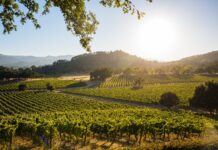
A Colorado native, he led his family’s construction business to the top of its category in the United States with uncommon enthusiasm and hard work, before building a winery in Napa Valley from scratch in the early 1970s. Far from settling into a peaceful retirement in California, this unrepentant builder created Joseph Phelps Vineyards by acquiring 240 hectares of land on the north-eastern flank of Napa, in Saint Helena, in 1973. He immediately planted multiple grape varieties on around 100 hectares (“He wanted to try everything,” his granddaughter says today) in an area that was then very remote from the alluvial and volcanic heart of Napa. These experiments led him very early on to imagine a flagship cuvée for his production, which was highly original at the time in a region where single varietals were the norm: Insignia is a “Bordeaux blend” composed not of a single vineyard selection of Cabernet Sauvignon, but an annual blend of the best batches produced.
 THE JO PHELPS SAGA
In forty years of this second career, until his death in 2015, the patriarch and builder made his ranch and his signature one of the biggest names in Napa. Insignia collected 100 out of 100 points in the 1990s and 2000s, becoming the archetype of generous, intense, woody Napa reds. Seven years after his death, his heirs sold Joseph Phelps Vineyards to LVMH. The French group took over a vast enterprise, owning no fewer than nine vineyards throughout Napa, as well as a gem in Sonoma, Freestone, where Pinot Noir and Chardonnay express themselves with extraordinary tension on steep slopes.
Committed to his idea of creating a holistic viticulture, integrating other crops and livestock farming, and sharing this world with his customers and visitors, David Pearson thought carefully before responding to the group’s proposal. “When they contacted me, the first question I asked was, ‘How are you going to sell this wine?’. Their sincerity and the way they answered convinced me that they were determined to develop this skill. The challenge was not only to make Phelps work, but to regenerate it in every aspect: the vineyard, the wine and the hospitality. That’s what really interested me. The project was not just about maintaining the business, but about bringing in a real “fine wine” culture. I’ve been here for a year now, and we’ve spent a lot of time defining what that means. We have identified seven key points that are essential for us. The aim is not just to increase profits, but to establish ourselves while remaining true to our values. What was sorely lacking when I arrived was a clear vision for the future of the estate, a project focused on the quality of the wine, while also reinventing hospitality to attract visitors.
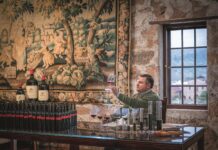
Indeed, when you arrive at this magnificent property, which looks like a ship sailing between vineyards and hills, built of solid wood and cut stone, you are immediately welcomed by hosts and hostesses who organise various experiences for wine lovers or groups of wine lovers, including tours and tastings of the estate’s wines. A resident chef creates delicious food and wine pairings for the happy few who visit. In the highly formalised and often inaccessible world of prestigious wineries, this focus on hospitality is already proving appealing.
“The important thing is not just to sell wine, but to sell it well. It’s about offering it to people we know, who share our values and our sensibilities. People are looking for experiences and access to authenticity. They are aware of this because it is offered as a product. The idea is to give the impression of being on a journey, in a meaningful and valuable experience, which allows you to rediscover the vitality of the soil, t of creating a vegetable garden and to understand how biodynamics works. Visitors want to see and understand the work that has been done. It’s about sharing this passion. For me, it’s a continuum: the idea is to experience, even if only for a moment, the life of a winemaker or farmer. It reconnects people with each other.
But it quickly becomes clear that the other – and most important – challenge for a man as experienced as David Pearson lies elsewhere: keeping Jo Phelps alive in general and his Insignia cuvée in the contemporary circle of international grands crus. In France, accustomed to immutable classifications, grands crus and other names mythologised for eternity, we often forget that a great wine is also the product of an era, its tastes and trends. Here, such an oversight would be fatal.
“In the United States, the approach is more focused on current marketing. If a wine is no longer perceived as being of the highest quality, it risks losing its value quickly. The emphasis is more on novelty than longevity,” notes Pearson. And rightly so: many famous Californian wines from the 1950s, 1970s and 2000s have lost their aura for good following a change in fashion or ownership. Insignia is no exception to this rule. What made it successful twenty years ago, the principle of blending as well as its opulent, oaky style, is now perceived as hindering its current development.
Having historical roots is not enough for a wine in California. “It can give the impression of a museum, offering authenticity and credibility, but the product must also be in tune with current expectations. A wine must resonate with its era; this is crucial. The challenge is therefore to evolve its DNA while remaining relevant and anticipating the future. Ten years ago, when we talked about fine wines, we thought about ageing and the idea of tasting a wine in fifteen to twenty years’ time.
Today, young people no longer think in the long term. They live in uncertainty and question sustainability. They buy fewer properties and cars and invest less in long-term commitments, preferring to live in the moment. Organic viticulture and an emphasis on agroforestry that is much more natural in this outlying area of Napa than in many other prestigious vineyards, refinement of style with a successful emphasis on drinkability, identification of plot selections specifically focused on specific terroirs, exposures and soils, teams are working on multiple fronts to combine excellence and contemporaneity in a landscape where the future is never written.
Based in the village of St Helena for decades, David Pearson is the opposite of a mercenary. He is a man of the soil: “For years, I have been expressing my fear that Napa will become a major tourist destination where, among other things, wine is made. The challenge for Napa is whether it can last for several more centuries. Making great wine is one thing, but the first hundred years are the hardest to get through. We’re not there yet, but we’re on our way.”