Luc Morlet brings precision to wines in California. The son of a Champagne winegrower, Luc Morlet left early for California, where he earned a reputation as a talented and meticulous winemaker. With his American wife, he established a winery that produces single-vineyard wines in Sonoma and Napa with impressive precision and depth.
Fairy tales must exist, and the story of Jodie and Luc Morlet proves it beyond a doubt. In fact, the wines that this Franco-American couple produces on small plots in both Napa Valley and Sonoma County bear fairy tale names on their French labels. Ma Douce, Ma Princesse, Joli Coeur, Billet Doux and many others are wines that combine the romanticism of their names with particularly impressive intensity and depth.
The story begins with a family from Champagne who settled in Avenay-Val-d’Or, a wine-growing village in the Montagne de Reims, north of Aÿ. Luc’s father produced champagnes there and, from his earliest childhood, Luc never thought of doing anything other than becoming a winemaker. After studying oenology in Reims, viticulture in Avize and the wine business in Dijon, family circumstances led Luc to Orly to pick up a young American woman who was spending a few weeks in France. It was love at first sight (a cuvée that does not yet exist in the current range) and Jodie and Luc have been together ever since.
Luc emigrated from Champagne to the Médoc (to Dauzac), then to California, where he quickly found work in several Napa wineries as an assistant and then head winemaker. He learned his trade, refined his style and reveled in this world of success stories and hard work. Leaving winemaking to become a consultant, notably for the famous Peter Michael Winery, Luc created Morlet Vineyards with Jodie in 2006. He immediately defined his credo: to work carefully selected small plots (he refers to this as “manicured viticulture”), vinify them in the traditional way, with an ambitious and highly appealing ageing process, and develop a creative craft.
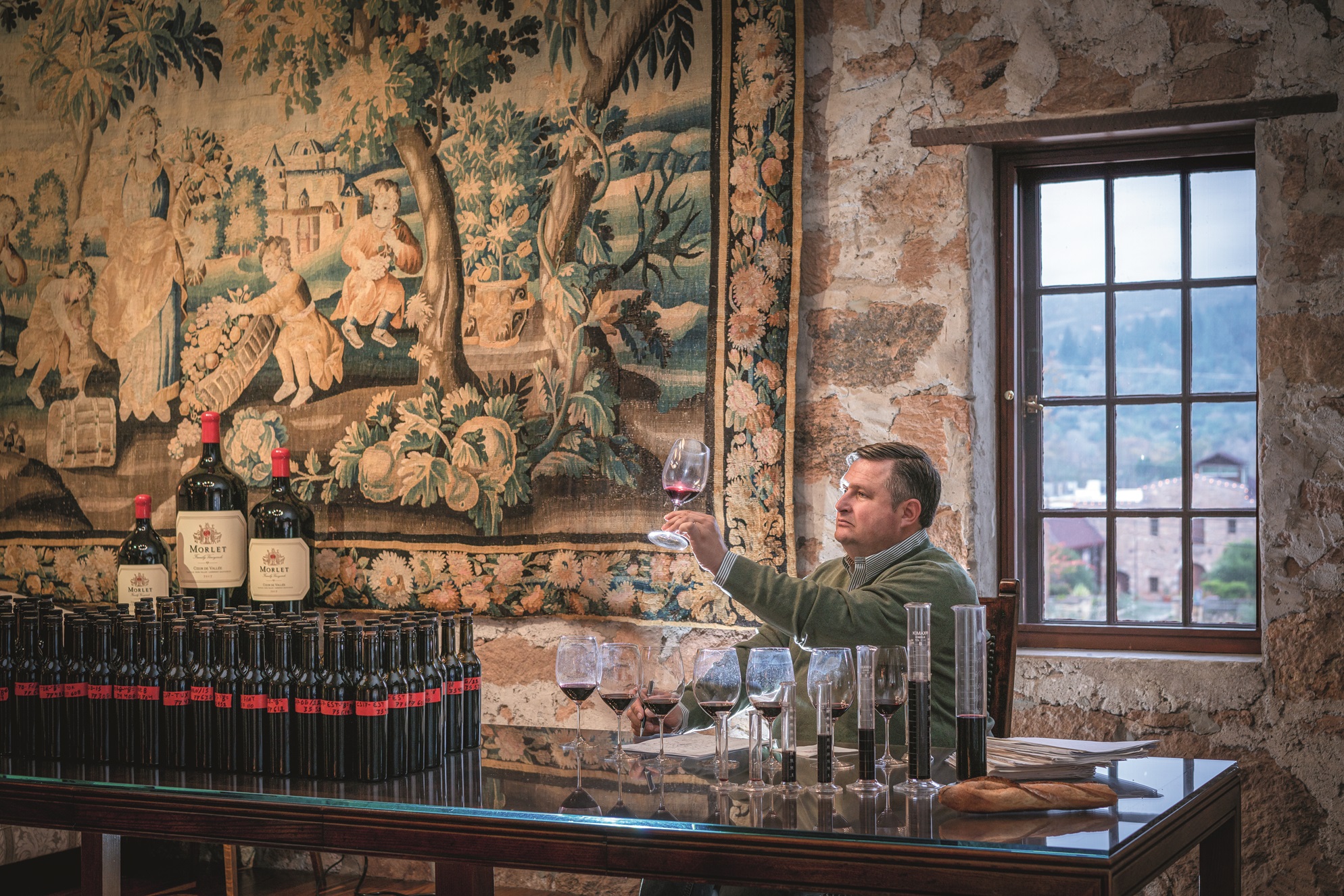
The Morlets gradually bought land, but also rented other plots in different areas of Napa and Sonoma. The small vineyard plots are effectively cultivated like gardens, and Luc Morlet takes a keen interest in how the great classic grape varieties respond to very different terroirs. His range is therefore very broad, exploring Pinots and Chardonnays, but also Sémillon in Sonoma, Cabernet Sauvignon and Franc in Napa. In St. Helena, Jodie and I tasted a large part of their production, covering several vintages and a mini vertical tasting for the final chapter of their Californian fairy tale, the brilliant Coeur de Vallée cuvée.
The heart of Morlet
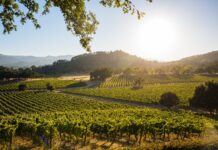
Coeur de Vallée lives up to its name: the ten-hectare plot stretches out of Oakville along Highway 29, which runs along the western edge of Napa Valley, from Napa to Calistoga, to To Kalon Creek on the eastern edge. All of Napa’s historic properties are nearby, and the Morlets took a risk in acquiring what has become the heart of their estate. Recognised as a rising star from the outset, the cuvée produced here is now established, the only one of Luc and Jodie’s wines to be distributed outside the United States by the Bordeaux market.
“We acquired ten hectares in a single plot. What’s incredible is that this land once belonged to the heirs of a beer empire. They encountered difficulties with this property and eventually abandoned it. It lay fallow for 45 years until we took it over, which helped us in two ways. First, the price was lower, and second, from a technical standpoint, the nematode populations were among the lowest in the region.
European professionals who discover Napa are always a little sceptical about the ability of this flat valley floor, covered with sediment and volcanic dust, to produce illustrious and expensive wines. They are even more sceptical when faced with these young Cabernet Sauvignon and Cabernet Franc vines. Yet all the vintages impress with their vigour.
Luc Morlet explains why. “The soils are well-drained and not very vigorous, thus avoiding the excessive stress that can be encountered in the higher areas of the hillsides. Furthermore, it is important not to fall into the trap of overly fertile soils, which lead to dilution and excessive yields, thus depriving the wines of their expression and personality. The challenge is therefore to find the right balance. But on other terroirs, I have never seen such marked expressions of the vintage as I have seen here. Is this linked to the site itself? Or to the fact that the vines are still young? I cannot say for the moment, but the future will tell.”
Tasting notes by Luc Morlet and Thierry Desseauve
The wines of Sonoma County
Ma Douce 2020, Chardonnay, Fort Ross-Seaview
L. M.: “The name is primarily a tribute to my wife. It also comes from the ‘gentle breeze’, a reference to the maritime influence of the region. By choosing a vineyard so close to the ocean, I initially thought I would produce a rather austere Chardonnay, marked by iodine or saline notes. However, I underestimated the altitude. Located above the fog layer, the vineyard enjoys milder temperatures at night and early in the morning. This contrasts with the more pronounced heat of the inland areas. As a result, our Chardonnay, grown at an altitude of 400 metres, remains very delicate, without ever being austere.
The vineyard is leased and we work each plot with care, controlling every stage of cultivation. Many people think that the only important decision is when to harvest, but there is also fertilisation, pruning, debudding and detailed work. The English term “gentle hand” reflects our approach: discreet intervention, favouring gravity for the treatment of the wine. We use indigenous yeasts, although over time, some may be selected naturally in the cellars. Our aim is to respect this diversity by accompanying the wine during the fourteen months of fermentation and ageing, exclusively in French barrels.
A very smooth Chardonnay, without the slightest hint of softness. The overall impression is elegant and straightforward, subtly playing on floral notes and hints of orange zest, enhanced on the finish by a welcome salty harmony. Rich, deep and creamy, delicate and velvety. 93/100
Coup de Cœur 2020, Chardonnay, Sonoma Coast
L. M.: “This is a selection from our entire Chardonnay production. We have another vineyard, Ma Princesse, which generally provides the majority of the batches, although some also come from Ma Douce. It’s rarely 50-50, it varies depending on the vintage. Coup de Coeur is intended to be a kind of ideal. We place less emphasis on the expression of the terroir and more on the expression of the vintage. This is what we call ‘seamless’. It is an important quality criterion when selecting barrels. The other criterion is the wines’ ability to age and become even more complex over time.”
Deep, smooth, brilliantly constructed, full-bodied and very fresh. The long finish combines generosity and smoothness, with superb aromatic persistence on floral and mineral notes. 95/100
Coteaux Nobles 2020, Pinot Noir, Fort Ross-Seaview
L. M.: “Coteaux Nobles is a nod to the surname of the owner of the Nobles plot. The important thing is to obtain volatile compounds to lengthen the wine, give it depth and bring out those high notes which, over time, will improve. As a winemaker, I try to avoid overly pronounced strawberry aromas, favouring instead those of cherry, morello cherry or even wild cherry.”
Generous and remarkably balanced, with a deep and subtle length, floral notes and the delicate fruitiness of morello cherry, finishing with a magnificent impression combining intensity and smoothness. Luc Morlet’s Pinot Noirs are particularly seductive. 95/100
Joli Coeur 2020, Pinot Noir, Fort Ross-Seaview
L. M.: “We do everything we can to control the temperature of the grapes, which is why we harvest at night and use refrigerated trucks. Our grapes arrive at a temperature of 10 to 12 degrees, and then we carefully sort them, berry by berry, bunch by bunch. All this is done using passive energy, the old-fashioned way. The fermentation curves are an integral part of the vintage. When it comes to fermentation, there is always an initial latency phase, which lasts between four and seven days. We start at a low temperature, which explains this delay. After this phase, fermentation continues for a fortnight, followed by maceration for twenty-one days, which is about a week longer than our Burgundian friends.”
This parcel selection of Coteaux Nobles brings added precision in terms of aroma, combining morello cherry with superb minerality marked by graphite, but also in terms of mouthfeel: finesse and length, creamy harmony, pure delicacy, subtle length and immense fruity persistence. A marvel. 97/100
La Proportion Dorée 2012, Sémillon, Sonoma County
L.M.: “Personally, I love Sémillon. It may seem a little discreet at first, when it’s young, but it’s what brings weight and texture to the mid-palate, which is what I’m looking for. And of course, it’s known for its longevity. It’s funny to see that it’s become trendy today, when we started producing our first wines in 2006.”
In this vintage, the blend consists of Sémillon (71%), Sauvignon (28%) and Muscadelle (1%). Full-bodied on the attack, harmonious and deep on the palate thanks to a permanent and intense fresh tension. Beautiful notes of honey and beeswax, enhanced by invigorating nuances of citrus zest. 95/100
Mon Chevalier 2012, Cabernet Sauvignon, Knights Valley
L. M.: “The first vineyard we developed is called Mon Chevalier. It is based on the five Bordeaux grape varieties, with a clear majority of Cabernet Sauvignon. This vineyard is located in Sonoma County, but in its warmest part. Most of the time, it is the last one we harvest.”
This lively cuvée fits into a range where the other wines are more focused on smoothness and richness. Here, we find an energy that brings a beautiful dynamic to the whole. The wine is straightforward and spicy, developing expressive fruit with a tangy finish. It is very original and intense, ultra-lively. 98/100
Wines from Napa Valley
Morlet Estate 2012, Cabernet Sauvignon, St. Helena
L. M.: “This wine combines a classic and hedonistic style, made from 100% Cabernet Sauvignon. What’s interesting is that it comes from three distinct micro-terroirs. The soil is similar to that of Coeur de Vallée, with an alluvial base covered with volcanic ash and clay. I named this wine Morlet Estate because it represents our home, where we live.”
Charming and deep, this is a rich Cabernet Sauvignon with notes of blackberries and black cherries. Generous, intense, fruity, smooth and deep, it develops a remarkably flavourful body, marked by the freshness of the fruit. 96/100
Passionately 2012, Cabernet Sauvignon, Oakville
L. M.: “We have the freedom to select the best barrels from our three estates, as this is a 100% Cabernet Sauvignon. Of course, it is mainly based on the Cœur de Vallée estate, which is the largest, but we also have barrels from Morlet Estate and Mon Chevalier. Above all, I named it Passionnément in tribute to my wife. The key word for this wine is harmony. It’s about creating a perfect union between the three vineyards. For me, it’s total fulfilment.”
Among Luc Morlet’s wines, this is perhaps the most typically Californian Cabernet Sauvignon, with its richness and flamboyant ageing. Full-bodied and rich, indulgent and hedonistic, it expresses intense fruit in all its facets. The tannins are well-integrated and the freshness is still there. 97/100
Force Tranquille 2019, Cabernet Franc, Oakville
L. M.: “The composition of the grape varieties is reversed, with 85% Cabernet Franc and 15% Cabernet Sauvignon. With Franc, the harvest window is not very wide. You have to be careful, because you can’t afford to let the grapes overripen. If that happens, it’s over. For Cabernet Sauvignon, on the other hand, if it is not ripe enough, it poses a big problem because you get notes of bell pepper. So you have to seize the perfect moment; it’s precision work. Force Tranquille has a slightly wild side, with notes of meat and fresh leather.”
Cabernet Franc is still rare in Napa, but it has produced a magnificent wine of impressive perfection. Icombining brilliant fruitiness with pepper and subtle spice, and exceptional vigour. A powerful wine, this precise and wild wine develops unforgettable vigour and intensity. 98/100
Coeur de Vallée, Cabernet Sauvignon, Oakville
2018
The 2018 vintage is fairly classic, with lots of energy, which is typical of a young vineyard. We are seduced by the wine’s smooth finish and energy. 95/100
2019
A profound wine, structured by very silky tannins and truly harmonious overall. From the first sniff, the wine reveals great complexity. On the palate, there is impressive generosity, a creamy depth, a sappy and ripe finish, rich in fruit expression. 98/100
2020
This vintage, sadly memorable in California for being the year of the great fire that nearly engulfed the northern slopes of the valley, was harvested here before the fires started. It offers seductive roundness and soft tannins, with great smoothness and intensity, enveloping richness and very persistent aromatics. 99/100
2021
This vintage stands out for its new dimension, which is less full-bodied and more subtle. The aromatic palette seduces with its fine spices and floral and fruity freshness. The finish is invigorating and delicate, revealing a new, ultra-elegant facet of the vintage. 98/100