At the heart of the Osterberg grand cru, the Clos du Zahnacker, the garden of Alsace is a rarity in the landscape. Three grape varieties combine to make the wines of this historic Ribeauvillé vineyard shine
DATING BACK TO THE 13TH CENTURY, the plot known as the Zahnacker (Zahn’s garden, in both Alsatian and German) belonged to a monk from Ribeauvillé, Martin Zahn, who farmed it on behalf of Étival Abbey in the Vosges. The Ribeauvillé wine cooperative, the first of its kind in France, founded in 1895, became the owner of its 124 ares between 1935 and 1965.
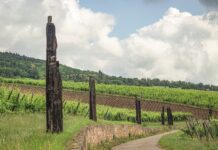
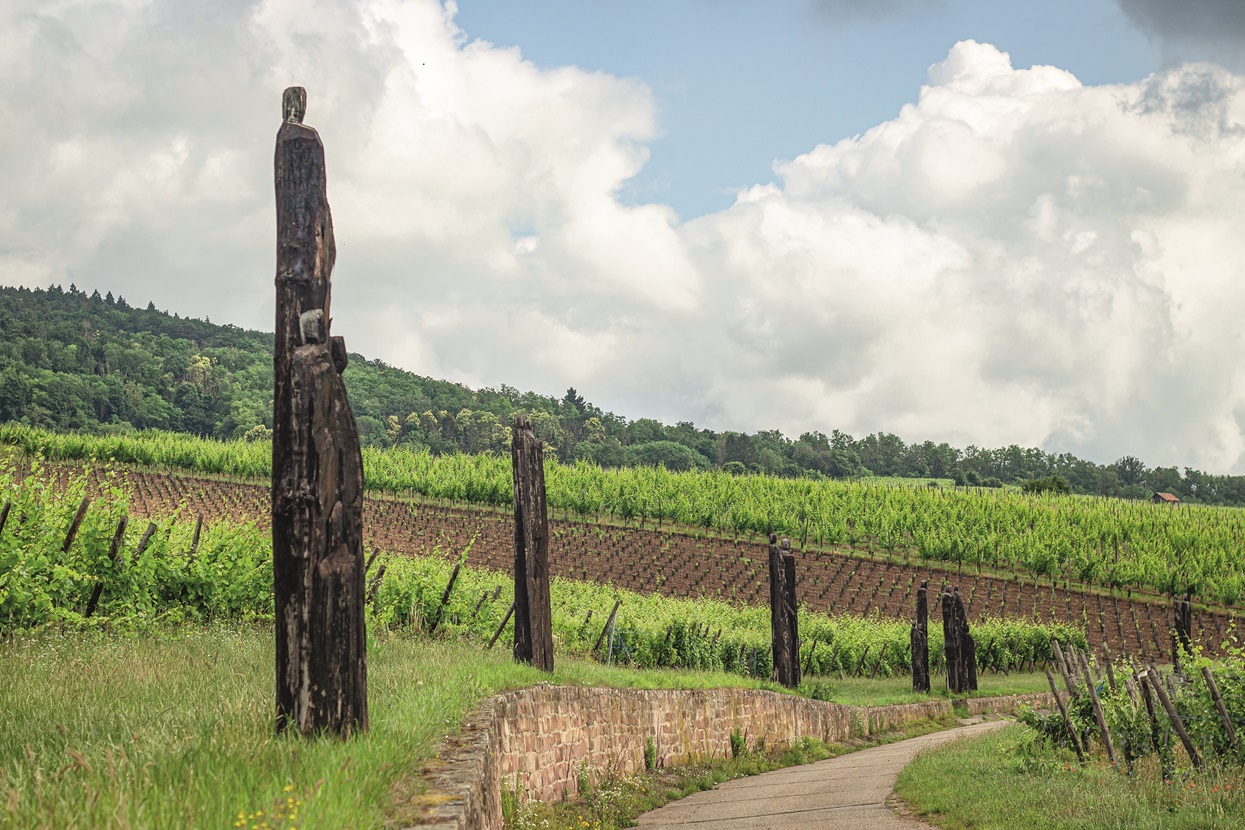
Situated within the Osterberg – a German term for a slope facing east – the vineyard, easily spotted from the foot of the hillside, is framed by imposing wooden sculptures by Christian Lapie. The very stony, marl-limestone soil is planted with Riesling (40%), Pinot Gris (30%) and Gewürztraminer (30%) and divided into three plots entrusted to three separate cooperative members. Nothing remains of the Muscat once planted here, having been grubbed up in the 1960s.
The different grape varieties are blended in the cellar, in varying proportions that reflect the vintage’s yields each year. Because the Osterberg Grand Cru decree does not recognize this blending practice, Clos du Zahnacker can only claim the Alsace appellation for the wine. At least for the time being, as the winery’s management is working to have this recognition extended.
Until 2007, the vineyard team harvested all the vines at the same time; since 2008, they have picked each grape variety at its optimum ripeness. The grapes are then pressed, settled and kept cold, with the blending of the three varieties carried out in juice to ensure harmony. The cuvée is inoculated with yeast when the final juice is added.
Oenologist Évelyne Bléger-Cognacq explains: “This cuvée is never chaptalised, yet it is remarkably consistent. It always reaches between 13.6 and 14.3 degrees potential alcohol at blending.”
Vinification then takes place in temperature-controlled stainless steel vats, without malolactic fermentation to preserve the wine’s freshness. Ageing is carried out on the full lees, with racking as soon as the first signs of reduction appear, always in stainless steel vats. As for bottling, this takes place between May and September following the harvest. The average production of this cuvée is between four and five thousand bottles, sometimes including a few magnums.
Whilst the first vintage vinified at the estate dates back to 1936, President Yves Baltenweck describes 1955 as ‘an extraordinary year’. To date, the oldest vintage kept in the cellar is 1971. When a year does not meet the required standards, the wine is not released for sale. This was the case for the 2006 vintage (affected by botrytis) and, more recently, 2021 (powdery mildew).
Over the decades, the Clos du Zahnacker cuvée has established its identity, evolving towards greater purity and drier wines. One finds the character of a wine from limestone soil, with that fine acidity that structures the palate, and often bitter notes capable of softening the residual sugar after around ten years of ageing. The dominant grape variety of the vintage is generally evident in the blend, but as Évelyne Bléger-Cognacq acknowledges: “The great years for Riesling are often the best.”
Clos du Zahnacker 2019
A fabulous fullness. We love the intensity of the ripe fruit aromas. Among the citrus notes, grapefruit and mandarin dominate. On the palate, the rounded texture reflects the sunny character of the vintage, and the slight residual sugar (10 grams per litre) is beginning to develop body. Another great bottle in the making, which will age for a very long time and be sublime in twenty years’ time. 95/100
Clos du Zahnacker 2017
Salivating acidity, a lovely lemony tension that lingers on the palate, allowing one to savour the pure, fresh lemon juice, with very pleasant bitter notes. Great precision. The acidity is well-balanced. It promises to join the 1989 in the annals of legend and to age just as well. 94/100
Clos du Zahnacker 2016
Already more mineral on the nose, the fruitiness returns on the palate. The balance is gradually coming together, but it still shows a slight residual sweetness before the bitter notes on the finish. 92/100
Clos du Zahnacker 2015
A strong residual sweetness, a little too pronounced for this wine, which will struggle to taste dry one day. But this is precisely the profile of the vintage, particularly in Riesling! 91/100
Clos du Zahnacker 2014
A year with almost no Gewürztraminer in the blend, as the grape variety suffered from fruit flies. On the other hand, the splendour of the Rieslings is fully revealed. It tastes almost dry, with delicate citrus aromas (lemon), and a lingering, mouth-watering finish. A favourite of ours for this highly atypical vintage. 94/100
Clos du Zahnacker 2013
The nose opens with candied citrus. On the palate, the wine has already consumed its sugars, revealing sharp bitter notes on the finish. A wine for fine dining, perfect with fish in a cream sauce. 93/100
Clos du Zahnacker 2012
Slightly more residual sugar than in the 2013 and 2014 vintages, at least to the palate. On the palate, this vintage betrays slightly too high yields: it finishes a little short and lacks the sharp verticality of the finest examples. 88/100
Clos du Zahnacker 2010
In this vintage, which contains very little Gewürztraminer (less than 5%), the very ripe Pinot Gris grapes lend the nose notes of mushrooms, undergrowth and chestnuts. The Riesling is less noticeable than in other vintages, but the bitterness and acidity characteristic of the Osterberg are present. Attractive, but atypical for this cuvée. 93/100
Clos du Zahnacker 2001
A superb minty freshness in the aromas. Slender, flavourful, with lovely purity and a touch of finesse for this wine as it enters its maturity phase. Not flamboyant, but precise. A luminous quality that is very appealing, finishing with a salty aftertaste. 91/100
Clos du Zahnacker 1996
A subtle hint of white truffle on the nose, typical of 1996 Alsace wines. The fruitiness takes on a jammy quality. On the palate, the sweetness is still very much present, combined with truffle aromas, making this a superb wine for fine dining: foie gras, truffles, poultry. It would have gained in precision with slightly less sugar, as its acidity is lovely. 93/100
Clos du Zahnacker 1993
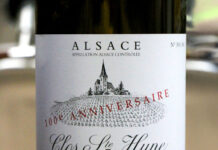
The winery’s centenary cuvée, released in 1995. A very exotic nose, with a pronounced presence of Gewürztraminer, perhaps a little excessive. At the time, winemaking did not achieve the same level of precision; all the grape varieties were harvested and fermented together. The bitter notes become more refined as the tasting progresses. It is certainly worth decanting, as it improves with aeration. 92/100
Clos du Zahnacker 1992
On the nose, the Gewürztraminer’s minty aromas dominate: it was the variety’s year. Nevertheless, the slightly harsh tannins on the palate and the vegetal notes show that the phenolic ripeness was not as advanced as it is today. Since then, we have gained in precision, both in viticulture and in winemaking. A year of very high yields. 88/100
Clos du Zahnacker 1989
Now at its peak, characterised by noble bitterness and great finesse in the aromas, with notes of chanterelle mushrooms and dried fruit on the palate, lovely spices (white pepper) and a caressing texture of great elegance. A great wine for a great vintage. 94/100
Clos du Zahnacker 1983
A lovely nose, now fully mature: mushrooms, dried fruit, undergrowth. On the palate, it is clear that yields were generous at the time, yet this wine remains refined and elegant. The Riesling dominates the expression; it is the standout grape variety of 1983! It should not be left too long before drinking. 89/100