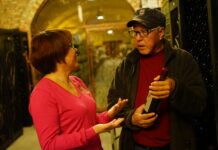
At the foot of the Dolomites, in the austere Trentino region where vineyards stretch across dove-grey mountain slopes, Elisabetta Foradori is the undisputed queen of Alpine viticulture. Having successfully revived her region’s native grape varieties with a serenity earned through hardship, she is reviving the past.
TRENTINO. First there is the name, which sounds like something out of an Italian children’s storybook. It is well known to high-altitude enthusiasts under the more noble name of Trentino-Alto Adige. A region that was once Austrian, whose wine production flowed into the cellars of Vienna, once extremely wealthy, but left drained by the First World War, which annexed its destiny to that of Italy.
For decades, all that remained was the sepulchral vision of superb, completely empty cellars, like the one that would become the property of the Foradori family saved from bankruptcy by a takeover in the early 1920s by the grandfather of the woman who would later become one of the most respected figures in Italian viticulture. ‘I started very young, I was 19,’ admits Elisabetta Foradori, almost apologetically, as she recounts her early days on the family estate without exaggeration.
The sudden death of her father Roberto at the age of 38, when she was just an 11-year-old only child, left her mother in charge of the vineyard, supported by two long-standing workers. ‘We sold our wines in the surrounding trattorias, simple wines, table wines.’ In an Italy still dominated by cooperatives, the family tried to stay the course, bottling their own wines to escape the fate of ever-falling prices. When Elisabetta took over the reins of the estate in 1984, it was hardly known beyond the confines of the valley. However, the young woman already aspired to find her own path, which would not be that of Super Tuscans and other standardised Cabernets.
“I didn’t want to devote myself solely to vines, but also to flowers and trees. I always wanted to see the vineyard as a forest. ‘ In this cramped Trentino region, wedged between lakes and mountains, she is convinced that it is possible to produce reds and whites of great finesse from indigenous grape varieties with sweet names such as Teroldego, Nosiola and Manzoni Bianco, which nevertheless retain ’that earthy and characterful side that you find in the people here”. Her meeting with the man who would become her husband, Professor Rainer Zierock, a German philosophy enthusiast, marked a turning point in her approach to the profession. “He taught me to look at plants, to understand genetics, to see agriculture from a different angle. ”
This union would produce not only three children, Emilio, Théo and Myrtha, but also an intuitive, almost animistic approach to viticulture. Elisabetta Foradori then set about practising mass selection and reintroducing forgotten forms of polyculture, but the road was arduous. ‘We had to survive without betraying ourselves.’ Among those who helped her embrace biodynamics, the famous Alsatian winemaker Marc Kreydenweiss was a true mentor. His unwavering support enabled her to convert the entire estate in just two years. Unfortunately, achieving balance would take much longer.
PASSING ON ONE’S IDEAS
Then came recognition and initial success outside Italy thanks to her reviving the past with her Granato old vine cuvées. A black grape variety as intriguing as an eclipse. It enabled her to ‘break out of the region and showcase the beauty and power of Dolomite reds’. Success, however, was slow in coming. ‘It came late,’ she admits.
In 2010, the conquest of the American market, followed by the awakening of a new Italian audience, finally changed the game, but not without some sacrifices. ‘Some distributors didn’t follow suit, but I couldn’t see myself changing course.’ It was ultimately with her whites that Elisabetta Foradori achieved true fame, particularly those made from Nosiola, a grape variety that had disappeared from Trentino, which she revived through amphora vinification.
‘We had lost this knowledge,’ she observes. ‘Working with clay is a whole art form, a mastery of the earth, but also of fire.’ Like Arianna Occhipinti and the Cos family in Sicily, Elisabetta Foradori is part of a generation of winemakers who have put indigenous grape varieties back at the heart of Italian wine identity. Her encounters with Catherine and Pierre Breton and Thierry Puzelat, leading figures in French natural wine, convinced her that emotion, even obstinacy, must take precedence over technique.
On the eve of her 60th birthday, Elisabetta Foradori can be proud of having passed the torch to the next generation, with her three children gradually joining the estate. This allows her to devote herself to her new passion for cheese production, which she simply sees as ‘another facet of the fermentation process’. As she prepares to make her first pilgrimage to the Georgian vineyards, she cannot help but express one last concern about the future of the profession. “The polarisation of the wine world does not seem positive to me. People are tired and confused by it all, and that’s our fault too. I think the time for change has come, but I don’t yet know in which direction. We must be patient and preserve what I like to call an ideal of beauty at all costs.”