In this era of alarming overconsumption, words chosen to describe the Mediterranean, the cradle of wine and viticulture, its past and its future. Thirty words chosen to express how much we love it, madly, passionately. That’s what a dictionary of love is all about. This one is written by a fervent defender of this world
A FOR ASSEMBLAGE (BLEND)
Although there are exceptions, the original tradition of southern wines is to be made from complementary grape varieties. This practice of blending – marketed on other continents under the red acronym “GSM” for Grenache-Syrah-Mourvèdre – is first and foremost an intelligent and pragmatic adaptation to the region’s climatic conditions, as the stylistic and agronomic characteristics of each grape variety often complement each other. But the most talented winemakers have refined their blends, combining grape varieties that were once considered ‘improvers’ (Syrah, Vermentino or Rolle, etc.), and sometimes also varieties described as international (Cabernet, Chardonnay, Sauvignon) with indigenous varieties such as Grenache and Mourvèdre, of course, but also Cinsault, Clairette and many others, to avoid the usual pitfall of wine standardisation.
B FOR BANDOL
A few rare Mediterranean sites emerged earlier than others, at a time when the image of wines produced in these regions was not particularly flattering. This was the case for Bandol. It is a wonderful Provençal terroir and the birthplace of a capricious but brilliant grape variety, Mourvèdre. Times have changed and many other interesting terroirs have emerged. But this historical pre-eminence commits the appellation to proudly maintaining its unique personality.
C FOR CEPAGES (GRAPE VARIETIES)
In our country of unrepentant administration, there has often been a desire to pit so-called international grape varieties – meaning depending on your beliefs, lacking authenticity or a self-proclaimed guarantee of commercial success – against ‘Mediterranean’ varieties. Even if it means taking a broad view of the Mediterranean, for example by placing Syrah from the northern Rhône Valley in the category: IGP and ‘Vins de France’ for Cabernets, Pinots and Chardonnays; AOC for Grenaches, Syrahs and Mourvèdres. This categorisation made some sense when growers had to restructure vineyards in the 1970s and 1980s, but it no longer today.
C FOR COOPERATIVE
Cooperation is part of the landscape in Languedoc, but also in the Rhône, Provence and Corsica. It is a major player, both in terms of its economic weight and its sociological dimension. Regardless of the quality of the cellars—which today ranges from excellent to ordinary, and is increasingly rarely mediocre depending on the operator and the wine-growing sector—the volumes produced and processed by cooperatives have a direct impact on prices. Consequently, these volumes also shape the image and reputation of both appellations and wines. Land use planning and the survival of many Mediterranean villages is another fundamental aspect of the issue that is too rarely highlighted. Some wineries, or groups of wineries, have successfully transformed their style and commercial approach. Many others are trying to build a future for themselves through an increasingly futile quest for autonomy and partnerships with large established or emerging operators.
C FOR CORSICA
Corsica is not only a paradise island inhabited by a people proud of their insularity, it is also a land of great wines. In a changing wine world, Corsica has a bright present and an even more promising future. The region can renew itself by drawing on its great diversity of terroirs, its wealth of grape varieties yet to be explored, and its wide range of production styles—moving beyond the current commercial supremacy of rosé.
D FOR DOUCEUR (SWEETNESS)
Once the pride of many Mediterranean vineyards, particularly Roussillon, but also Languedoc, the southern Rhône Valley and Corsica, sweet wines, often made from Muscat grapes for whites and Grenache for reds, enjoyed a long period of glory followed by a slow decline. In this era of triumphant mixology, Banyuls, Rivesaltes and other Muscats may now be able to invent a new future for themselves, provided that innovation is on the move…
G FOR GARRIGUE
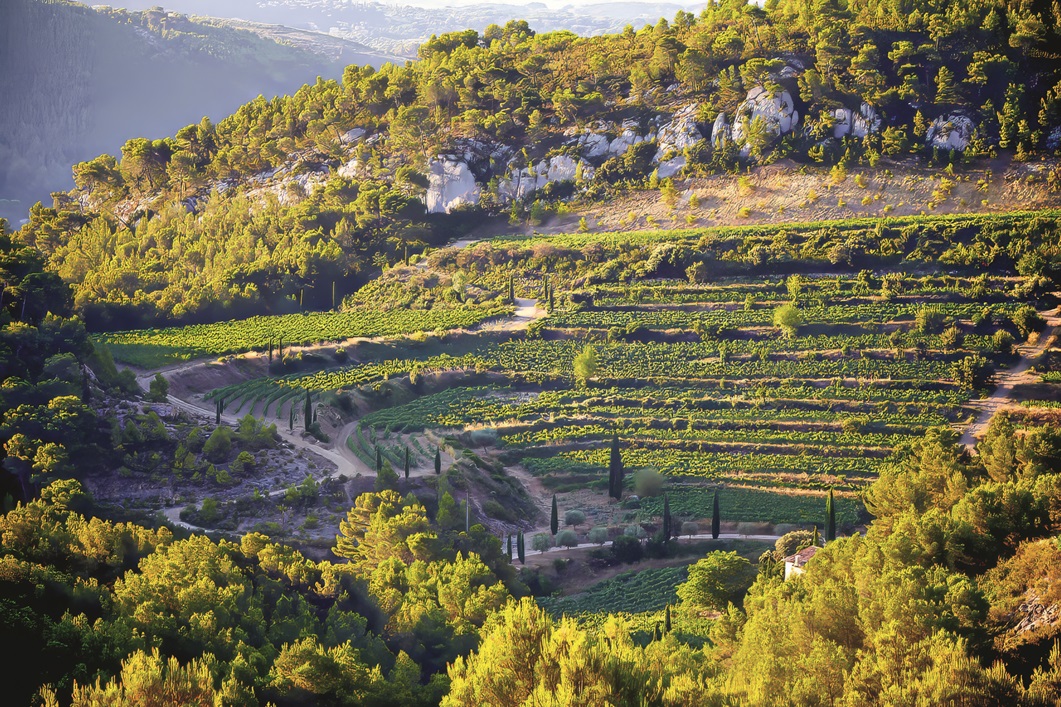
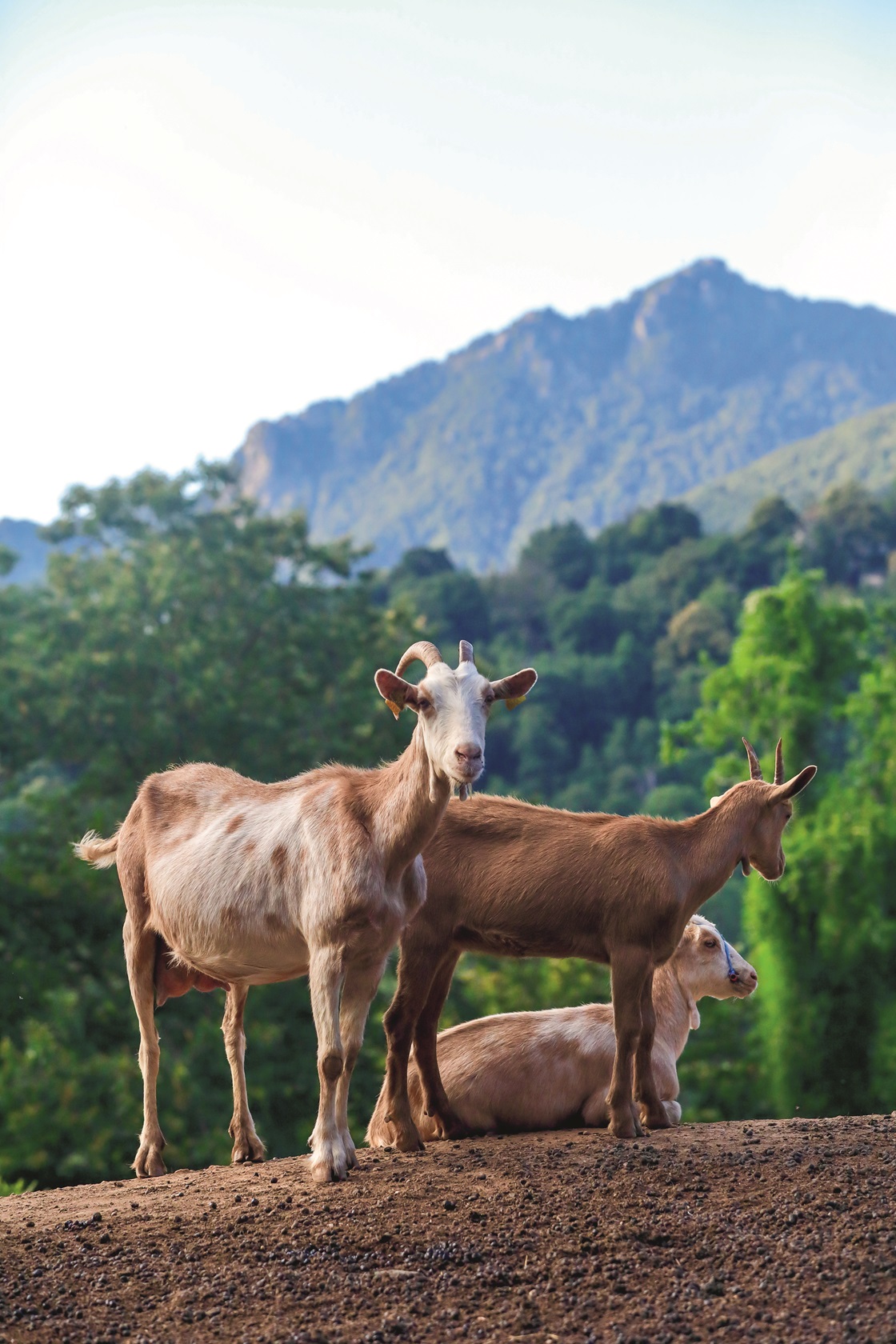
The quintessential Mediterranean landscape is enjoying a renaissance in the age of agroforestry: most of the vineyards in Provence, Corsica and Languedoc have always been part of a naturally diverse ecosystem. There are no oceans of vines in the Mediterranean.
G FOR GASTRONOMY
Drawing its roots and recipes from the diversity of local agricultural production, the cuisine of the Mediterranean basin is extremely tasty and varied. However, regardless of its geographical origin and mode of consumption, from street food to festive meals, it all has one thing in common: it always pairs well with wines, whether red, rosé or white. This aspect should not be overlooked, in this era of alarming overconsumption. On the steep slopes of Corsica, nothing has changed, or almost nothing. The farming community, with its traditions and proud identity, continues to be the great architect of this dream setting. It is also its guardian.
G FOR GRENACHE
For a long time, Grenache was considered a secondary grape variety. It mattered little that the Provençal Châteauneuf, albeit alongside twelve other varieties, owes much of its impressive authenticity to it, or that the great sweet wines of Roussillon are made from it. Its overly generous yields, supposed lack of tannins, light colours and propensity for oxidation all contributed to a generous but unremarkable profile. Since the beginning of this century, it is an understatement to say that its image has been prodigiously transformed. Provided its proverbial generosity can be controlled, which is no easy task in these times of global warming, the grape variety combines aromatic nuances, finesse of texture and smooth richness like no other. It does not thrive everywhere, but if there is one Mediterranean grape variety that embodies the region’s identity, it is this one.
H FOR HISTORY
Archaeologists lean towards more distant regions – Georgia, Armenia – as the origins of the vine, but the Mediterranean was undoubtedly the cradle of wine civilisation. It remains an essential centre today, despite the development of viticulture by religious orders in the Middle Ages in the Rhineland and Burgundy, despite the spectacular development of vineyards boosted by English commercial activism, in Bordeaux and Porto for example, and despite the spectacular emergence of New World vineyards over the last century.
I AS IDENTITY
There is no single identity for Mediterranean wines, but countless identities, and it would be futile to try to caricature them with a single word or a few words. What do the structural rigour of Bolgheri Cabernets, the enveloping roundness of a Roussillon Grenache and the peppery spices of a Bandol have in common? Not much, except for their assertive character. For a long time, the region was known for producing anonymous wines, but today it stands out as a guarantor of personality and diversity.
J FOR JARDIN (GARDEN)
The Mediterranean coastline is a vast garden, wild in places, meticulously organised in others. Vines are part of the landscape, but they are very rarely alone. They coexist with a dense and diverse natural environment, where the plant and mineral kingdoms are harmoniously shared. There other food plants have been bearing fruit for thousands of years. Let us not neglect this enchanted garden, let us not destroy it: it is our history, our roots, our soul.
L FOR LANGUEDOC
In its long and rich history, Languedoc has experienced everything: wealth and poverty, dreams and despair, creativity and routine. A region almost entirely devoted to viticulture when the invention of the train led our provinces to specialise their production, Languedoc was the region that had to make the greatest effort to restructure an industry based on high-volume production for mass consumption. In fifty years, this enormous challenge has been met on multiple levels, both in terms of structures and markets. Not everything is perfect or complete yet. Languedoc is now a modern wine region, designed to produce quality wines and capable of adapting quickly to market changes.
L FOR LIBERTY
Even when they do not offer the most original version of their personality, almost all grape varieties can be grown in the Mediterranean basin. So why should they be classified administratively into various categories of AOC, IGP or now “vins de France”, even if it means distorting historical customs, placing Rhône Syrah in the camp of authentic appellations and Cabernet Sauvignon, which has been present in Provence since the 19th century, in that of PGIs or “complementary” grape varieties, which are inevitably in the minority in a blend? In these times of upheaval, could we not abandon once and for all regulations that are more political than natural, more temporal than historical, and give creators and entrepreneurs the great breath of freedom?
M FOR MISTRAL
Sunny, hot and dry: that’s the Mediterranean climate. But it’s also windy. Mistral in the Rhône Valley and on the coast, tramontane in Roussillon, the wind that blows here is strong and cold. It has always played an essential role in viticulture. Purifying the grapes, ensuring temperature variations between night and day, and drastically limiting the risk of rot in humid weather, the mistral has always been the vineyard’s faithful ally.
M FOR MUSCAT
Viognier is in vogue, so why shouldn’t Muscat be too?
N FOR NEW WINE GROWERS
All renowned vineyards have one thing in common: they attract new winegrowers who often develop new ideas and new production structures. Most wine-growing areas in the Mediterranean are no exception to this regenerative rule, but with very different profiles.
The ‘entry tickets’ are not the same for Provence (especially the coast), which is idealised around the world, Corsica, which is much more protective of its local players, and Languedoc-Roussillon, which is still undergoing structural reconstruction. Powerful players – large fortunes and large groups – are now setting the tone for Provençal viticulture, while the evolution of Languedoc and Roussillon has been driven by passionate and fiercely independent mavericks as well as local entrepreneurs who have spectacularly overturned an outdated family model. Ultimately, the innovation of some, the power of others and the roots of those who have always been there create a combination that is quite rare in the world of wine and undoubtedly very positive.
O FOR OLIVE TREES
Polyculture is a centuries-old tradition in the Mediterranean, and the Tuscans have perfectly symbolised it by almost systematically combining olive oil production with wine production. Except in certain areas, Mediterranean France does not have the same tradition of olive growing, but it can draw inspiration from this example to combine its wine-growing activity with other facets that give a holistic dimension to the business. Some do this through wine tourism, others, more rarely, through mixed farming projects, but the search for meaning is a fundamental aspect of wine culture.
P FOR PROVENCE
Provence’s wine industry is at a crossroads, to say the least. Since the early 2000s, rosé production has become a key driver of its development, initiating a shift that is better understood today: fewer red wines accompanying traditional meals, more rosé, white and sparkling wines for moments of conviviality. This glamorous transformation has attracted new investors, starting with the all-knowing LVMH. Although the group is the contemporary master of the game, it cannot replicate the strategy and methods that made it successful in Cognac and Champagne. Times have changed, and so have the markets. In the meantime, there remain a myriad of winemakers who are reinventing, each in their own way, a region that is much less uniform than is often imagined.
Q FOR QUALITY
No other region in France has made as much progress in terms of average quality as the Mediterranean basin as a whole. Looking back, this is a development that would have been incredible to imagine at the end of the previous century. However, this does not prevent some of the public and, unfortunately, the majority of professionals, especially in France, from still placing these wines in a secondary tier of the hierarchy: this is the real challenge for the coming years.
R FOR ROSÉ
Today, it dominates production in Provence, including in appellations historically renowned for their reds, such as Bandol, as well as in Languedoc and Corsica. Rosé has carved out a lion’s share of the market, with codes that differ from those that have governed quality wines for decades. Rather than attempting to analyse the multiple causes of this tidal wave and its ability to last, let us simply highlight two significant aspects. Firstly, thanks to rosé, Mediterranean vineyards have entered a new world of consumption, and even a new imaginary world beyond the confines of their traditional image. Rosé, twenty years ahead of its time, also heralds a major shift in wine consumption, less focused on reds intended exclusively to accompany meals, and more open to other occasions and styles, where rosé, but also light reds, orange wines, whites, sparkling wines and non-alcoholic wines will have their place.
S FOR SALINITY
Curiously, freshness, tension, minerality and salinity have long been absent from the organoleptic vocabulary of Mediterranean wines. It has been the personal struggle of certain producers to introduce these words into the profile of their wines; this remains a major challenge in this era of climate change.
S FOR SYRAH
What if this grape variety, well established on the granite or schist foothills of the Massif Central, on the slopes overlooking an alpine river, the Rhône, 250 kilometres from the coast, was not quite at home in the Mediterranean? Yet it has been planted (almost everywhere), still considered an “improving” grape variety, almost always forgetting that south of the 45th parallel, it often offers a conventional version of its qualities, with notes of blackberry jam and chocolate, coated tannins, but often drying on the finish and with a woody finish.e parallel, a conventional version of its qualities, with notes of blackberry jam and chocolate, coated tannins, but often drying on the finish and a flattering but ultimately caricatural woodiness. Syrah certainly plays an interesting supporting role in the multi-varietal construction of Mediterranean wines, but it is certainly not a miracle recipe for success.
T FOR TERROIR
The Mediterranean terroir remains largely misunderstood because its immense diversity is often overlooked. It is the climate assumptions – maximum sunshine, low rainfall, frequent droughts, hot summers – that dominate our understanding of the vineyards and falsely unify a vast and complex territory. In fact, variety is everywhere: geology, geography (from the sea to the mountains, often just a few kilometres apart), exposure, microclimates, historical practices, grape varieties and even the vision of the activity. No other wine-growing region is as rich in different terroirs.
U FOR UNIVERSALITY
Life in Provence is the stuff of dreams for the whole world. Wine from Provence, not yet.
V FOR VERMENTINO
Like Syrah for reds, Vermentino – also known as Rolle in Provence and Vermentinu in Corsica – was seen some thirty years ago as a miracle cure for the then disastrous landscape of white wines in south-eastern France. Unlike Syrah, this grape variety has the advantage of being native and well-suited to the Mediterranean terroir. Although it has not escaped a few clumsy caricatures, it has produced a number of convincing successes and, above all, given local winegrowers a new ambition for white wines.
W FOR WINEMAKER
More than anywhere else, traditional production categories have stifled the development of Mediterranean vineyards. By often creating a systemic opposition between winemakers, cooperatives and merchants, those involved in the wine industry (particularly in Languedoc-Roussillon) were certainly recalling an emancipatory historical truth, but were wasting time when it came to the real issues of the day. Worse still, many professional influencers, wine merchants, sommeliers and journalists persist in despising the work of wine merchants, who are nevertheless the driving force behind the revival of these regions, underestimating cooperation and uniformly celebrating the ‘small is beautiful’ approach that is supposed to be the rule for winemakers. In fact, the Anglo-Saxon concept of winemaking, regardless of the producer’s pedigree, is much more relevant for gauging the current evolution of the sector.
X AS IN XERES (SHERRIES) AND OTHER SURPRISING WINES
Let us expand our dictionary for a moment to include the entire Mediterranean basin: from the nutty notes of sherries to the saffron notes of Muscats from Cap Corse, from the marvellous spices of Banyuls soleras to the ripe fruit of Bekaa wines, what other region in the world can boast such a variety of flavours, as well as winemaking styles and expertise?
Y AS IN YACHT
Even if the coastal marinas are crowded with yachts as spectacular as they are ostentatious, the Mediterranean is not a paradise for the rich. It is also the sea of great migrations and their tragedies. Since ancient times, it has been the beating heart of civilisation. And since those same ancient times, wine has been a symbol, a trade, a way of life, a source of happiness.
Z FOR ZEST
Like minerality, citrus fruits and, even more so, their zest were not part of the Mediterranean imagination a few years ago. They first arrived in the Mediterranean in the somewhat caricatural form of grapefruit aromas (which oenologists call thiols), which became prevalent in many rosés, replacing the equally crude notes of strawberry candy or nail polish. But today they make up the increasingly complex and diverse bouquets of Mediterranean whites and rosés, integrating into a brilliantly complex palette of flavours and aromas.
Photo Serge Chapuis