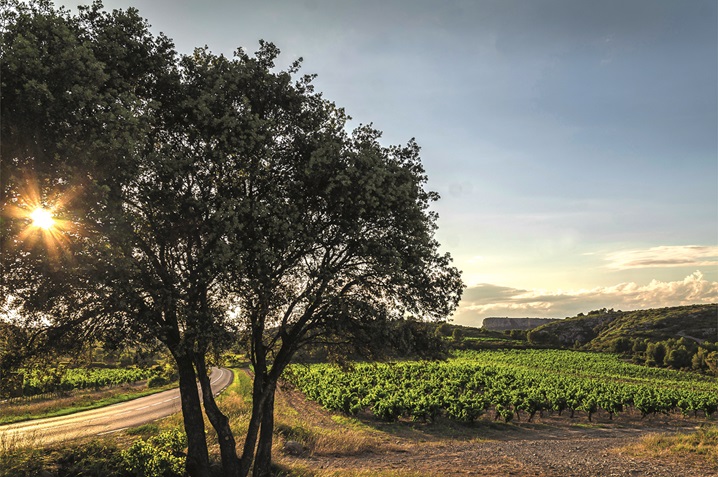
The heart of the vineyard, Languedoc is the region where so much has happened in Mediterranean viticulture. After a long search for its identity, the region is now ready to take its place among the elite of modern wines thanks to its first-rate terroirs. Exploring the Mediteranean terroirs with our expert
Identifying the best terroirs in Languedoc is no easy task. The best terroirs in Burgundy have been identified for centuries and the best Bordeaux châteaux have been known for a long time. Although Languedoc probably has the oldest vineyards in France, its history of producing high-quality wine is very recent. It was in the region known as Narbonnaise, as early as the 6th century BC, that the first vines were planted in what would become France. Viticulture gradually took root on the hillsides.
Recognised for its quality, wine was exported from the end of the Middle Ages onwards, without anyone really identifying the best terroirs. Then the industrial revolution of the 19th century and the wine needs of the growing urban population and military encouraged the production of inexpensive wines in very large volumes. The plains were massively converted into vineyards. The phylloxera pest and consumers’ desire for higher quality wines plunged the region into a series of crises throughout most of the 20th century. The inventory of Burgundy’s terroirs, the most comprehensive in the world, took a thousand years of harvests to classify the potential of each vineyard plot. Although wine research only progresses at the rate of one trial per year, modern geology will enable Languedoc to move faster.
But it was not until the late 1980s that a new generation broke with tradition and began a gradual return to quality viticulture. Today renowned, the wines of the Pic Saint-Loup vineyard were unknown to the inhabitants of nearby Montpellier thirty years ago. Those from the Larzac terraces were only known to a few enthusiasts twenty years ago. Our understanding of each terroir is still in its infancy and our identification of the best ones may change significantly in the coming years, especially as it is largely a story of motivated men and women. While the Terrasses-du-Larzac, Pic-Saint-Loup, La-Clape and Boutenac appellations are currently ahead of the game, the Languedoc region’s quality wines cannot be limited to these areas alone. Many terroirs are very promising, but sometimes lack the driving force to make them benchmarks.
This is the case for the Faugères and La Livinière appellations. In Pèzenas, those that once existed are either at a standstill or in the process of being revived. Producing reds that are much more convincing than in the past, the Fitou appellation has been rescued from oblivion by at least three producers. The Saint-Chinian AOC, which also sorely lacks notoriety, has all the potential to return to the spotlight. Many quality winegrowers operate there and the terroirs are remarkable, including the satellites of Saint-Chinian, the Berlou and Roquebrun appellations. With its fairly diverse soils, the Grés-de-Montpellier appellation could rank among the most sought-after, as it was once expected to include the Languedoc’s most legendary estate, Peyre Rose.
However, due to the lack of sandstone in the soils of its vineyard, it does not claim it. And yet, grès is not necessarily made of sandstone, note the meaning of the accent. In Occitan, “grès” refers to poor, stony hillside soils, which are very suitable for growing vines, but not necessarily made of sandstone. We recently held a tasting of wines from the appellation, which revealed a series of reds with very fine tannins. They are therefore worth keeping a close eye on. Cabardès recently impressed us with a tasting of some magnificent vintages. It is a terroir to watch, like its neighbour Malepère. And let’s not forget the rosés of Cabrières, which Gérard Bertrand is trying to position at the top of the Languedoc colour spectrum, a place undoubtedly deserved for this little-known area.
TERRACES OF LARZAC
690 hectares of gravelly, stony soil.
This area, which was part of the Languedoc hillsides, became a specific appellation in 2014. Currently covering only red wines, the Terrasses du Larzac AOC brings together around a hundred producers based in thirty-two municipalities. This vast high-altitude terroir lies north-west of Montpellier and stretches to the Pas de l’Escalette towards Millau, on the collapsed area of the Larzac plateau. It forms a V shape dotted here and there with small islands of vines.
A closer look at the different types of soil reveals considerable diversity, including alluvial terraces, scree, colluvium, Jurassic limestone, Permian red sandstone and basalt. It is therefore not the soil that is the characteristic marker of the appellation. The proximity of the Larzac plateau, at the foot of which it lies, and the relative altitude bring coolness to the summer nights: ideal conditions for the slow and gradual ripening of the grapes. Many of the wines are highly complex in texture and have great ageing potential, with different dominant aromas such as garrigue in Jonquières or lychee in Puechabon and Aniane. The freshness of the wines, made possible by the altitude, which peaks at nearly 700 metres, is the common thread running through all the wines produced in this area of the Languedoc, which has the highest quality potential in the region.
This dynamic appellation has a number of excellent, motivated winegrowers, 70% of whom use organic or related farming methods. The logical approach would be to further segment this area to highlight the specific characteristics of each sector, such as Aniane, L’Escalette, Jonquières, Saint-Privat, etc., in order to move closer to the concept of grand cru as it is identified in Burgundy, Alsace or Champagne.
Our selection
Mas Jullien
Domaine Cassagne et Vitailles
Clos Constantin
Domaine de l’Accent
Domaine de Montcalmès
Pas de L’Escalette Estate
Mas Cal Demoura
Mas Combarèla
Le Clos du Serres Estate
Mas de la Seranne
Château La Sauvageonne (Gérard Bertrand)
Mas des Chimères
Château des Crès Ricards (Paul Mas)
Mas Lasta
Les Vignes Oubliées
Mas Laval
PIC SAINT-LOUP
1,350 hectares on dolomite and marl limestone soils
This terroir, which was part of the Languedoc hillsides, became a specific appellation in 2017. It currently covers red and rosé wines and brings together eighty marketers based in seventeen municipalities. Located near Montpellier to the north, backed by the Cévennes foothills, the terroirs of this appellation are diverse. Some are located on the foothills of the Hortus and Pic Saint-Loup (658 metres) massifs, while others are on flatter areas.
On closer inspection, the soils can be very diverse in nature, including hard limestone, soft limestone, dolomite, conglomerates, fluvial limestone scree, marl and gravel near Corconne. As with the Terrasses-du-Larzac appellation, the defining feature of Pic-Saint-Loup lies not so much in its soils as in its climate, which creates significant temperature variations between day and night during the ripening period.
In the future, it will be necessary to segment its wines and highlight the different terroirs. We would like to give a special mention to the reds produced in the Gravette de Corconne area, as they are so distinctive: a very particular and distinctive mineral taste seems to us to be the very definition of a specific appellation, but this is not the only area of great interest in this sector.
Our selection
Clos Marie
Château Lancyre
Château de Lascaux
Clos des Reboussiers
Mortiès Estate
La Chouette du Chai
Mirabel Estate
Mas Bruguière
LA CLAPE
800 hectares of hard limestone, clay and scree soils
This terroir, which was part of the Languedoc hillsides, became a specific appellation in 2015. Run by around thirty producers based in six municipalities, the La Clape appellation currently covers red and white wines, with the exception of rosés and Est . Already planted with vines under Julius Caesar, this area between Narbonne and the sea stretches 17 kilometres from north to south and the same distance from east to west.
A significant part of the vineyard is located on the La Clape massif, between the sea and the town. The winegrowers cultivate biodiversity here, and you have to climb to the top, to the Pech Redon estate, to understand the majesty of this appellation. Although the altitude reaches only just over 200 metres, the massif dominates the surrounding area, where the landscape shows little relief. From canyons to valleys, the pine forest, vineyards and garrigue often look out over the Mediterranean.
The red wines are deeply intense with good brightness and are among the most identifiable when tasted. They take on smoky, bacon-like nuances complemented by the salty notes brought by the sea spray. On the nose, balsamic aromas dominate with scents of pine resin and eucalyptus as well as garrigue scents. The acidity is good, these are wines that age well, and should be left for three to five years before drinking. Produced by several winegrowers, this is one of the highest quality appellations in the Languedoc. In white, Bourboulenc thrives in certain areas and can produce excellent wines. It is often blended with Clairette, Grenache Blanc, Roussanne and Rolle.
Our selection
Château Pech-Redon
Château La Négly
Château L’Hospitalet (Gérard Bertrand)
Château Rouquette-sur-Mer
BOUTENAC
220 hectares on limestone, sandstone and molasse soils
Unlike the Terrasses-du-Larzac AOC, which is a sub-regional appellation, Boutenac has enjoyed a communal appellation under the INAO for twenty years (for its red wines), just like Faugères, La Clape and La Livinière. This level of appellation is possible when the vineyard is located in a maximum of ten communes. Previously known as Corbières-Boutenac, the cru has been a fully-fledged AOC since 2024, run by around forty marketers. Carignan is the main grape variety here, and it is the Languedoc region that produces the best wines.
These are not the most aromatic reds, but they are fresher than those produced from the traditional Syrah, Grenache and Mourvèdre varieties.
Under the scorching Languedoc sun, this wine draws its invigorating freshness—essential for ambitious reds—and combines it with deep colour and generous aromatic complexity marked by notes of spices, ripe fruit, and garrigue. With its focus on Carignan, the Boutenac appellation is unlike any other in Languedoc.
Our selection
Château Ollieux-Romanis
Château de Caraguilhes
Château de Villemajou (Gérard Bertrand)