Madiran, at the top of the Pyrenees. The Madiran appellation produces convivial and generous red wines, reflecting the men and women who make them. The time has come to review its assets. They are considerable
The medieval village of Madiran, located about forty kilometres from Pau, gave its name to the vineyard, whose origins date back to Antiquity. The boom in wine growing in this region owes much to the arrival in this small village in 1030 of Benedictine monks who founded the Priory there. Madiran wine naturally became a sacramental wine and its popularity was assured thanks to the many pilgrims on their way to Santiago de Compostela, whose route passed through the village.
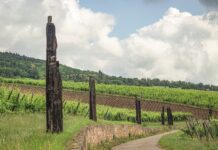
In this region with its unspoilt ecosystem, rows of vines find their place in the landscape alongside pastures, diverse crops and forests. All this with a breathtaking and spectacular view of the Pyrenees mountains. Only a minority of winegrowers here live solely from the vine. Almost all of them have maintained a supplementary activity in cereal farming and, less frequently than in the past, in livestock farming.
The rest of the landscape is fairly straightforward: the good terroirs at higher altitudes are used for vines, while the valley floors and plains, where the soil is richer, are used for cereals (maize thrives in this region) or livestock.
Today, the Madiran vineyard covers 1,200 hectares, spread over three departments and shared between 145 winegrowers, 45 of whom are independent. All the others belong to the appellation’s two cooperative wineries . The vineyard’s location can be summarised as being between the mountains and the ocean, 60 kilometres north of the Pyrenees and 80 kilometres east of the Atlantic coast.
The vines, planted on hillsides that are often steeply sloped, reveal significant geological variations due to the formation of the Pyrenees mountain range. They are also subject to a very particular microclimate, as the high rainfall in the area is combined with local winds under the dual influence of the mountains and the ocean. The late season is particularly mild, with warm days combined with cool nights allowing the grapes to ripen well. All these factors contribute to the character and diversity of Madiran wines.
One king grape variety and two great styles Tannat accounts for 70% of the appellation’s vineyards. It is sometimes overlooked, but it can be blended with Fer Servadou, another grape variety from the Tochtone region, as well as Cabernet Franc and Cabernet Sauvignon.
Particularly well suited to the terroirs of Madiran, Tannat thrives on rich, cool soils where it produces delicious, expressive wines. When planted on poorer, stony or clay-limestone soils, it produces more powerful wines that are suitable for long ageing. For many years, these two wine profiles have tended to create two distinct styles within the appellation.
Purists have chosen to focus exclusively on Tannat when it is planted on the great terroirs of Madiran. With most winegrowers adapting to new consumer tastes by producing more modern, delicious, fruity and readily accessible wines, with long and appropriate ageing, it can produce magnificent wines that age remarkably well. Most winegrowers are adapting to new consumer tastes by producing more modern, delicious, fruity and readily accessible wines, often from a blend of Tannat and the two Cabernets, using different fermentation and ageing methods.
However, they cannot resist the urge to preserve the authenticity of Madiran by vinifying small batches “à l’ancienne” (the old-fashioned way), which serve as their “calling card”. Recently, Madiran has been undergoing a complete renewal. In ten years, more than a third of the estates have been passed on. While some of these transfers have allowed winemakers from elsewhere to set up shop, it is most often the next generations who have taken over these family estates.
It is worth noting that a large number of female winemakers have taken on these positions of responsibility. This enthusiastic young generation is keen to raise the profile of Madiran wines and commit to more virtuous farming practices by choosing organic viticulture.
21 REDS
Château Arricau-Bordes, Madame Alice 2020
Powerful and smoky, with notes of black fruit and a direct texture where the tannins are present. It offers a beautiful length on the palate. 90/100
Château d’Aydie 2018
A complex nose combining aromas of blackberry, raspberry and blueberry with peppery notes. Balanced tannins and a long finish full of character. 92/100
Château Barréjat, Extrême 2021
Intense aromas of black fruit and tobacco, structured on the palate with robust tannins, leading to a vigorous finish. Good potential. 90/100
Clos Basté 2020
Powerful aromas of ripe black fruit (prune) and tobacco. Warm and generous texture on the palate, quite flavourful, balanced by good tension on the finish. 90/100
Domaine Berthoumieu, Charles de Batz 2018
Great aromatic power between bright fruit, smoke, truffle and cocoa, with hints of violet. Its tight tannins will allow it to age well. 94/100
Château Bouscassé, Vieilles Vignes 2019
Floral finesse and incomparable aromatic precision. Intense on the palate, carried by numerous, very fine tannins. A racy finish, full of sap, with length and subtlety. 97/100
Domaine Capmartin, La Cuvée du Couvent 2020
Characterful with notes of ripe fruit and subtle spice. Soft and tight texture, with an elegant grain and pronounced liveliness on the finish. 90/100
Cave de Crouseilles, Crouzeilles-Côte Abeilles 2019
Aromas of violet, peony and red fruit, full-bodied on the palate, with lingering flavours and an energetic finish. 90/100
Domaine Damiens, Tradition 2021
Elegant and expressive, with fresh aromas of red fruit and wildflowers. Pleasant texture, very rounded and well-balanced. 89/100
Domaine Labranche Laffont, Vieilles Vignes 2020
Superbly intense nose with good complexity, elegant palate carried by remarkable liveliness, offering perfect balance and length. A refined wine. 91/100
Domaine Laougué, Marty 2020
Smoky, mineral, floral and black fruit notes. Melting texture on the palate, supported by fine tannins. A beautiful energy emanates from it. 90/100
Domaine de Maouries, Les Orchis de Pyren 2018 An explosive bouquet of red and black fruits, accompanied by chalky and floral nuances. A fleshy and flavourful texture, with a dynamic finish. 90/100
Vignobles Marie Maria, Grèvière 2020
Delicate aromas of spices, truffles and fruit, savoury structure with chewiness and tannins that are still a little firm. Good potential. 91/100
Domaine Monblanc, Métamorphose 2021
Delicate aromatic palette, with fruity, floral and spicy notes. Its fine texture and remarkable freshness make it an easy-drinking and pleasant wine. 90/100
Château Montus, XL 2019
Lots of aromatic nuances between powerful black fruits and undergrowth scents. A brilliant, deep, full-bodied and racy wine, with the finesse of tannins made possible by ideal ageing, the secret of which only the estate knows. A great wine. 96/100
Domaine du Moulié, Mademoiselle Chiffre 2018
Powerful aromas of ripe red and black fruits, with notes of saffron and menthol. Beautiful presence on the palate, with tension and a good finish. 90/100
Château de Perron 2020
Intensely fruity, with notes of cocoa. We love its generosity supported by vigorous tannins and its beautiful presence. 89/100
Château Peyros, “100” 2020
Complex and elegant with fruity and woody notes. Velvety texture and good persistence, reflecting careful vinification. 92/100
Château du Pouey, Triangle 2021
Elegant aromas of ripe red fruit and sweet spices, with hints of tobacco. A balanced and pleasant wine with a melt-in-the-mouth texture and remarkable freshness on the finish. 90/100
Domaine Sergent, Eucalyptus 2022
Rich ripe fruit and notes of eucalyptus, harmonious, rich and dense on the palate with a savoury texture. Its aromas linger on the finish. 92/100
Château Viella, Prestige 2021
Dense, deep and complex, with a structured palate, rich, tight tannins and a long, energetic finish. Lots of character. 91/100
photos by Fabrice Leseigneur